


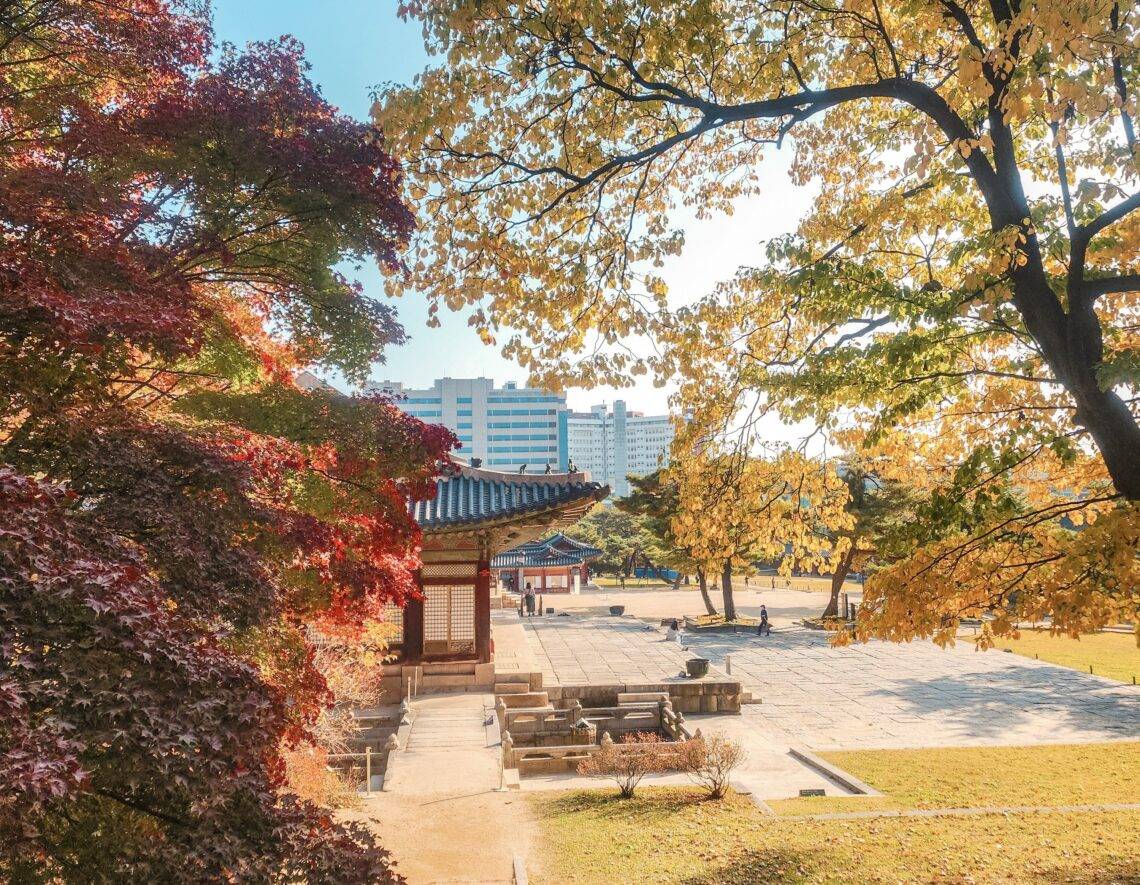
Seoul is a huge city covering 600 square kilometers, representing six times the size of Paris. It is therefore quite legitimate to ask oneself what to do in Seoul and how to visit it ! Just here, you will find almost one fifth of the national population, with almost 10 million inhabitants. First city and capital of South Korea since August 15, 1948, date of independence and the foundation of the Republic of Korea, following the end of the Japanese invasion.
In Seoul, you can almost do everything and see everything. The must-see places are numerous! Visit the palaces where the kings reigned, dive into the fascinating history of the country between Japanese and Chinese invasions, discover its extreme modernity. The expression often used for Japan and Korea “between tradition and modernity” is clearly justified here. This is all the more blatant within the capital. You will go from small traditional markets, to squares where old men, 할아버지 play the game of Go (a kind of lady), to crowded streets full of pop-up stores of all kinds, to huge cosmetics shops , to traditional hanok cafes… In short, you will be bombarded with places to visit in Seoul.
How long does it take to visit Seoul?
It is in Seoul that everything happens at the entertainment level, if you like concerts, festivals. Don’t miss the visit to this city if you want to be closer to both modern and traditional Korea.
5 days in Seoul is the minimum, even one week, because the city is so big, with so many things to discover, that it is difficult to make a choice. I gathered in the visits to Seoul, what I think are the unmissable for any traveler who lands on the peninsula. Places that are both closer to history, moments closer to Korean modernity, the typically Korean gastronomy approved by me, with my good addresses of restaurants and cafes.
You are obviously free to visit as you wish, but the city is so extensive, and time restricted, so I organized the places to do according to their geographical position, that it is a minimum feasible without you having to take 10,000 transports and avoid wasting time.
📌 If you are traveling longer and want to discover places to visit in the country, go to my article Visiting South Korea in 2 weeks 🔗.
Where to sleep in Seoul?
In the neighborhood of Bukchon Hanok Village, I recommend you to book a stay at the Luxury Hanok Cottage Nest. It is an incredible typical Koraean house with a jacuzzi.
For accommodation with an excellent value for money, you can choose the Seoul DDJ STAY. The room is small but the reception is incredible and it is very well located.
If you really want to treat yourself and discover a room that you will only be able to see in Seoul, l’Escape, a Luxury Collection Hotel can be a very good option. In addition to being exceptional, the hotel is ideally located in the Samcheong-dong district.
Visiting Seoul in 5 days: what to do and see first?
Regarding the practical information : how to get around, where to shop, where to have a drink… I will meet you in the FAQ at the end of the article to see all my advice!
How do I get from Incheon airport to the center of Seoul?
Once you arrive at theIncheon airport, you will need to reach downtown Seoul. The airport is very well served by public transport. Several options are then available to you: the taxi, the limousine bus or the metro with the AREX Express line or classic.
🚕 Taxi is the simplest option, especially if you are tired or very busy. He will drop you directly at your accommodation for a cost of approximately 50,000 to 70,000 won (or €35 to €50 depending on the distance and traffic).
🚌 The more economical alternative is the limousine bus. Tickets are purchased just before exit, at the counter marked ‘Bus’. I advise you to check in advance on the internet the line number that serves as close as possible to your accommodation. The journey costs about 17,000 won (€10), but the duration varies greatly: between 1 hour and 2.5 hours, depending on the arrival time and traffic jams. As an example, when joining my accommodation in Seongsu, east of Seoul, the journey took about 1h15 twice… but almost 2h30 when arriving around 16h, because of the traffic.
🚇 Finally, the most reliable option in terms of time is AREX, the metro line connecting Incheon and Gimpo airports to central Seoul.
Two possibilities exist:
- AREX Express, non-stop, connects Incheon to Seoul Central Station in 30 minutes for 11,000 won (€7).
- The classic AREX stops at 13 stations and takes a little over an hour, for a much lower rate of around 4,000 won (€2).
This is the option I have chosen in almost every trip to South Korea : it has the advantage of not depending on road traffic, but may be less convenient if you travel with a lot of luggage.
➡️ Discover my 3-week itinerary to visit South Korea
What to do in Seoul between tradition and modernity: first day
A one-day itinerary , ideal for a first trip to Seoul, mixing unmissable historic places, traditional neighborhoods, good local addresses and a lively evening.
⚠️ Attention: this day is to be avoided on Tuesday, the closing day of some palaces.
Gyeongbokgung Palace
⏰ 17h or 18h30 depending on the seasons (always check the times on KakaoMaps or Naver Maps).
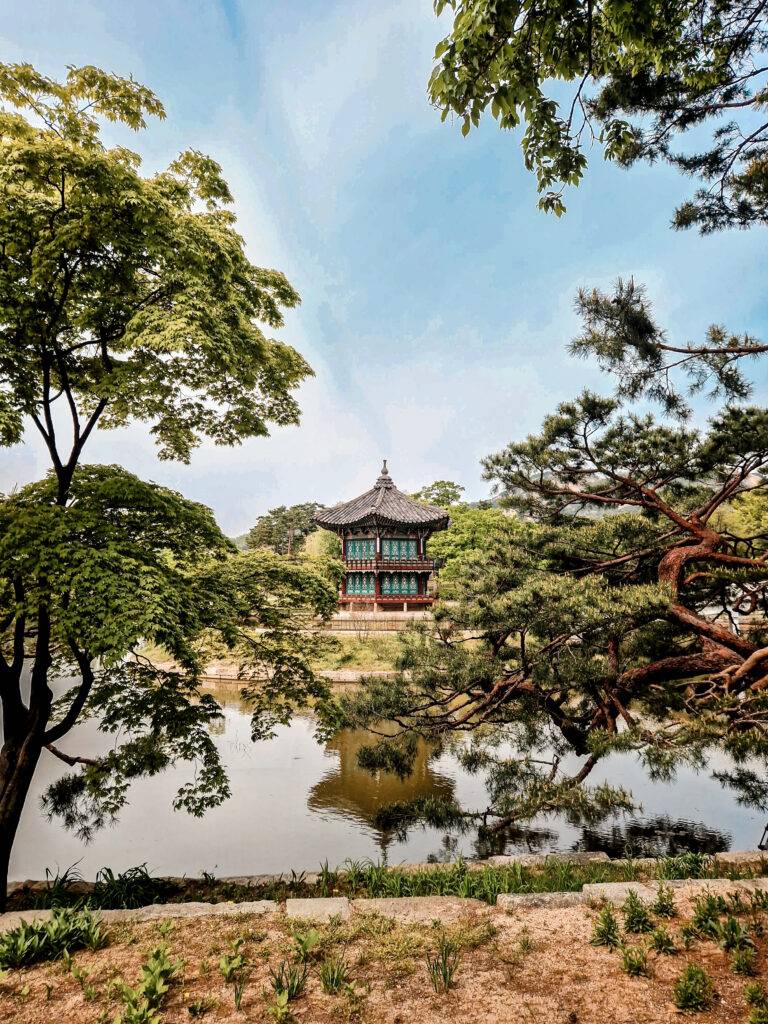
Gyeongbokgung is the main palace of South Korea, the largest and most iconic. It is the one we see the most in tourist photos. This is not my favorite personally, but it is clearly unavoidable for a first trip.
It perfectly embodies the expression “between tradition and modernity” since when you turn to face the door after buying your tickets, you will see modern buildings that surround the palace. Funny feeling but that perfectly summarizes Korea, especially Seoul.
The palace of Gyeongbokgung is immense! It takes 1h30, or even more, if you want to enjoy the place quietly.
🎟 Admission ticket costs 3000 won (less than €2).
Rent a traditional Korean outfit
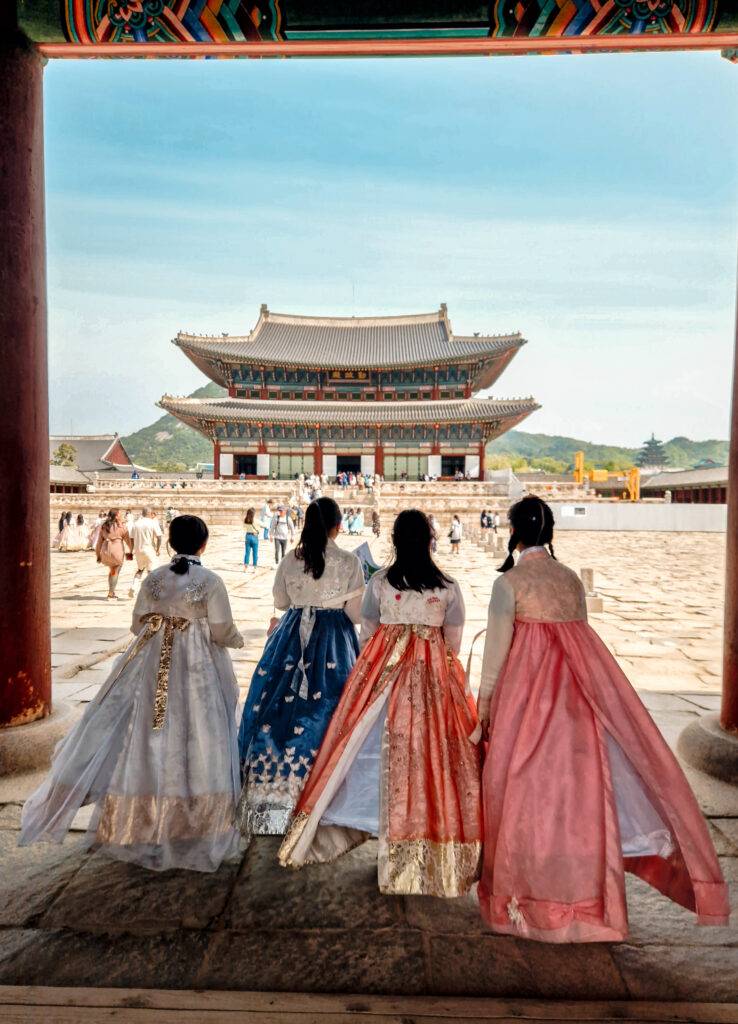
To extend the experience, I strongly advise you to rent a hanbok (traditional Korean outfit). The rental shops are located around the palaces. I tested Hanbok Town (한복타운), which offers classic to premium hanboks, with accessories (small bag, hair jewelry…).
💡 Good Deal to Know: with the hanbok, entrance to all palaces is free. Count on 15,000 to 25,000 won ( 9 to 15€) for 1 to 2 hours of rental.
📌 My practical tips for this visit:
Built in 1395, the palace of Gyeongbokgung was the first official palace of the Joseon dynasty (from 1392 to 1897). It is also the most visited with some 6,800,000 entries in 2025. I therefore strongly advise you to go there at the opening to avoid the crowd as much as possible, even if some tourist places like this are never deserted… Also avoid the weekend, you will have at least a few Korean families less.
Don’t hesitate to go to the bottom of the Gyeongbokgung complex: as it is very vast, many tourists stay in the center and do not go see everything. You will find there notably the pavilion on water 경회루 (Gyeonheeru), made famous by BTS, the largest group of Kpop today, who gave several performances for the Tonight Show.
Stay away from the crowd, as it can be very compact and downright unpleasant to visit. Some parts located more at the back of the palace are very little visited, enjoy them.
National Folk Museum of Korea
⏰ Open daily from 9 am to 5 pm. Admission is free.
Located within the confines of Gyeongbokgung, this museum is easily recognizable at its pagoda and grand steps. You can visit only the museum without doing the palace, or vice versa.
It is not very large and can be visited in about 1 hour. It is centered on the daily life in Korea through the eras: reconstructed traditional houses, clothing, objects, popular arts…
I visited it once and recommend it, but this is not a mandatory step if you are short of time.
Bukchon Hanok Village
Located east of Gyeongbokgung, adjacent to the palace, dive into THE traditional Korean neighborhood par excellence. We discover there the famous traditional hanok houses. Some are still inhabited, others transformed into restaurants, cafes/bars, guesthouses or shops. Stroll through the small streets of the neighborhood which are full of charm.
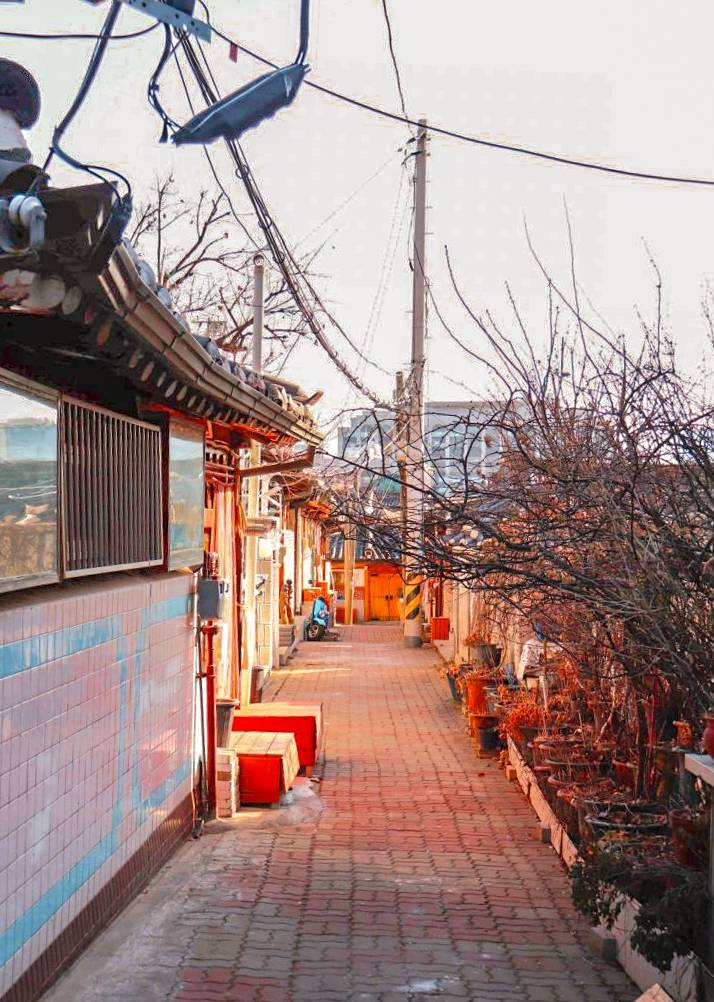
However, I recommend much less, although it is very pretty, the famous very (too) touristy street located to the north of the neighborhood: Bukchon-ro 11 Gil. It is full of people, between those who take their photos with their hanboks, those who want to photograph the Namsan Tower in the distance, and others who are there to appreciate the traditional houses.
💬 This street has been so successful that it is now off-limits between 5 PM and 10 AM. It is the result of too much noise and inappropriate behaviors for the inhabitants of the neighborhood. If however you still want to go for a walk, respect the schedules well, anyway someone is watching. And courage to you for the crowd…
📌 My good addresses in Bukchon Hanok Village
I rather recommend that you get lost in the rest of the neighborhood of Bukchon Hanoi Village, especially around the Jeongdok Library. You will find there:
- The Tea Therapy tea room, ideal for a break accompanied by a tea with the virtues you need
- The Adidas store, with models exclusive to Korea
- Small perfume shops, galleries, souvenir shops, cafes
- The O’Sulloc shop and tea room…
In short, you will have something to do. Stroll through the part of the Bukchon Hanok Village district that still remains authentic. For a lunch break, I recommend Thanks Oat, which offers bowls (especially acai) or good sandwiches. It’s not very Korean, but it’s excellent!
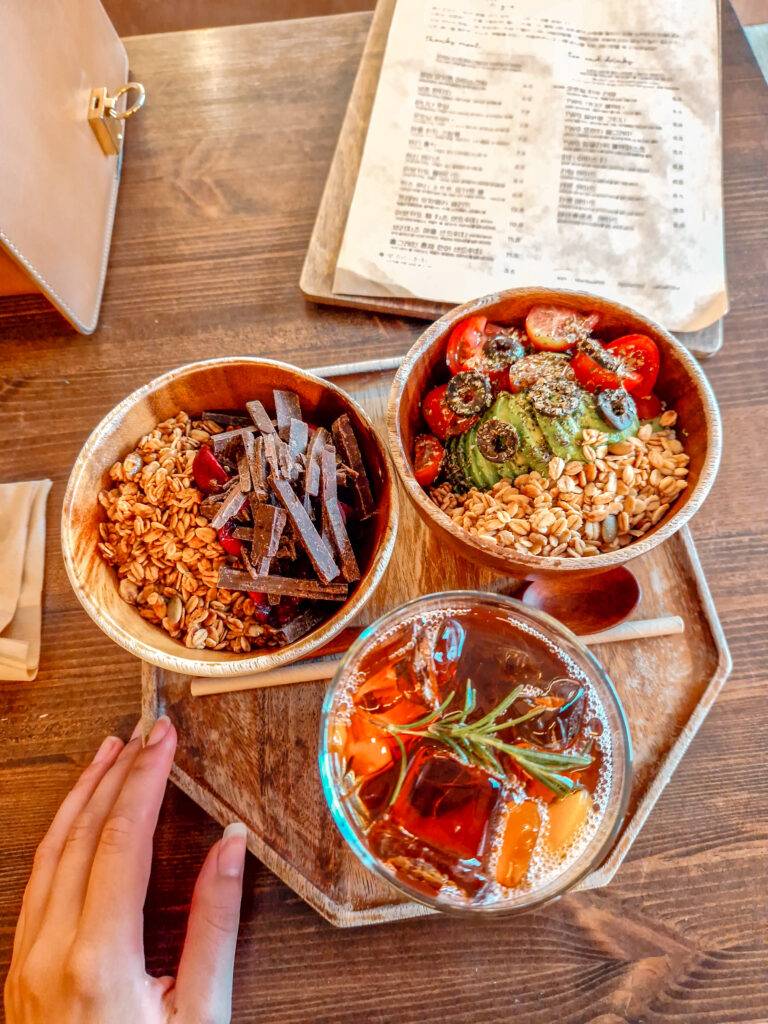
Discover the local cuisine : Kalguksu
If you want to eat a traditional dish, try kalguksu (칼국수). It is wheat noodles served in a broth, with variants based on chicken or seafood. You will pay a maximum of 12000 won (€8).
It is a dish often considered as summer by the Koreans, even if I do not agree because it warms very well during the winter cold too.
Samcheong-dong
Along the eastern rear of the Gyeongbokgung palace, you will arrive in the very pleasant district of Samcheong-dong. It is still spared by mass tourism. This neighborhood is not very big but very nice to visit, especially if you like galleries, cafes, shops…
The neighborhood extends to Samcheong Park, slightly elevated and particularly pretty in autumn.
For a local experience, I recommend the Seoul Seoduljjaero Jalhaneunjib, literally “the best restaurant in Seoul for the second time”. You will discover a coffee with as specialty the Ssangwha tea (or 쌍화차), a traditional medicinal type of tea. The taste is particular, but if you want to be closer to the culture, why not. For the snack, I advise you to try patjuk (or 단팥죽), a mixture composed of red beans and rice. It seems strange like that, but frankly it’s not bad. Know that red bean paste is well present in Korea and it’s frankly good with a sweet taste.
Finally, if you like cats, discover the pretty shop 호세도자기, specialized in ceramics. The boss particularly loves cats and you will see a whole bunch of superb and adorable objects. Many break, but you also have hair clips, bags… A gold mine!


Coffee shop with rooftop in Samcheong
Right across the street, the Four Stones Coffee Roasters is a huge three-story café with a rooftop in the heart of Seoul. Prices are reasonable, and you will discover the crazy architecture of cafes in Korea. If the weather permits, a spot on the terrace is frankly nice.
💬 Did you know? Seoul has more than 24,000 cafes, you will quickly understand that it is a truly full-fledged activity in Korea.
Seochon Hanok Village
Then, move the palace to the back this time to join the other traditional part of the Seochon Hanok Villagedistrict. Buk “북” in Korean meaning north, this time it’s to the west: “서” that one surrenders. Seochon Hanok Village is less popular with tourists, the atmosphere is different, but I appreciate just as much if not more than Bukchon. Many good places in the neighborhood, but the best already is to walk around, starting from the street that runs along Gyeongbokgung.


📌 My good addresses in Seochon Hanok Village
Here are my recommendations:
- The Chaeg chaaeg or 책책, literally meaning ‘book book’: small but very nice café-bookstore.
- 옷집 literally “the house of clothing”: a vintage clothing store.
- Scoff: a delicious pastry offering an incredible wide choice of cakes between brownie, cookie, carrot cake, lemon cake… I recommend EVERYTHING.
- Tongin market: to allow you to discover a small local market. To enjoy the experience to the fullest, exchange your money for coins that you will then use to buy food throughout the market. Taste the famous caramelized chicken 치킨, at tteokbokki (rice cake in a spicy sauce) 떡볶이, at the mandu (ravioli stuffed with vegetables, meat or kkimchi).
- the Boot coffee shop, located in a hanok, with an indoor terrace (the traditional architecture of the Korean hanok).


Dinner around traditional Korean dishes
If you are still hungry, I give you another good restaurant address in Seochon : the Seoul Jongro Gu Jahamunro Gil 26. To discover even more about Korean gastronomy, here is what you should try:
- The famous dakgalbi 닭갈비, made of chicken dice marinated in a fairly strong gochujang-based sauce, cabbage, and onions.
- I often order tteok (rice cakes) and cheese on the side, to make a more complete, better and less spicy dish.
Count 12,000 to 15,000 won per person if you add ingredients, which is €7.9.
Evening in the Hongdae district
To finish the day, head Hongdae, about 30 minutes west by transport.
Emblematic neighborhood of Korean youth, it lives mostly at night. Ladies, I warn you: some young and beautiful Koreans are there to flirt and meet strangers. 😂
In the early morning, Hongdae wakes up, few people stroll through the streets and it’s pleasant. At night, dive into the atmosphere of Korean youth and party, but not only. If like me you are not too partygoers, you can still enjoy Hongdae at night.
📌 What to do in the Hongdae district of Seoul?


Take exit 8 of the metro. For the fans of K- Beauty and their incredible products, go to the huge store Olive Young. Then, in front of the H&M, you will see young singing and dancing, where you can enjoy a musical moment.
Hongdae is home to clothing shops generally cheap and of varying quality, but some are not bad at all. You will find in Hongdae many cafes, restaurants, bars, clubs, located further south. To the west, it is the place of fashion street when you take it from the Hongik university stop, but also makeup shops, skincare, clothing, and stuff of all kinds. There are also karaoke, arcade games… You can spend hours exploring the Hongdae neighborhood.
To escape the festive atmosphere, I recommend the Colline café located further down in Hongdae, an institution. Large, magnificent, and obviously good. It often serves as the backdrop for drama scenes (Korean series). Colline offers good original drinks and to eat like pancakes or brunches.
Visit the district of Yeonnam Dong
If you still have energy, before returning, go take a little tour to Yeonnam Dong, located at thewest of Hongdae, at exit 3. This neighborhood is very trendy with many cafes, photo booths, and restaurants. It is much less crowded than Hongdae, but still known to Koreans.
I have many addresses in Yeonnam Dong, one of my favorite neighborhoods in Seoul :
- For a sweet break or simply to rest your legs, I highly recommend Milieuhaus, whose decor is reminiscent of ancient Europe, very pretty, it opens until 11pm and the milk tea is validated.
- For fluffly pancakes: simply go to Fluffy’s place, a much too adorable café, not very crowded and located below. It’s so good. You will have many other choices of cafes, but simply walking through these streets is already a good idea.
- For a really great bar address, head to Radio City, an establishment entirely decorated in the style of late-20th century England. You will drink cocktails as beautiful as they are good, and you can even choose songs to listen to. The owners are Australian and Korean, and are adorable.


Visit the must-see sights of Seoul off the beaten track and in the heart of modernity: day two 📍
An ideal day to discover a newer, creative and less touristy Seoul, while staying on unmissable places.
Dongdaemun Design Plaza (DDP)
First stop of the day: the Dongdaemun Design Plaza, better known as DDP.
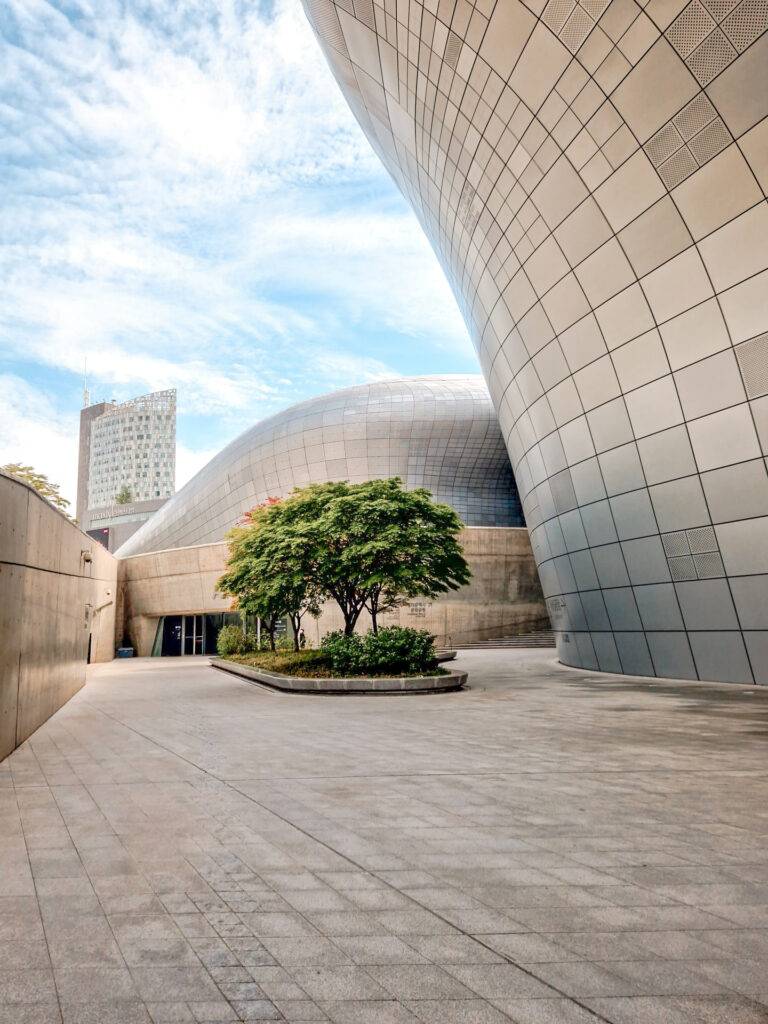
This very modern building, inaugurated in March 2014, was designed by the famous architect Zaha Hadid. He perfectly embodies the modern Seoul à la coréenne.
The DDP is a gigantic complex that houses inside a museum, shops, rooms, exhibitions… This is a must-have from Seoul. Don’t hesitate to enter inside, otherwise just taking a walk outside is enough, especially if you are not in Korea for modernity.
Then leave the building on your right, and you will reach one of the city gates, Honginjimun 홍인지문.
Naksan Park and the fortress of Seoul
Continue straight ahead and head towards the Naksan Park. It is located at a high altitude, so plan for good shoes. The walk is not very long and you will have a pretty view of the city. The neighborhood around it is very nice, I go there at least once during my stays in Korea.
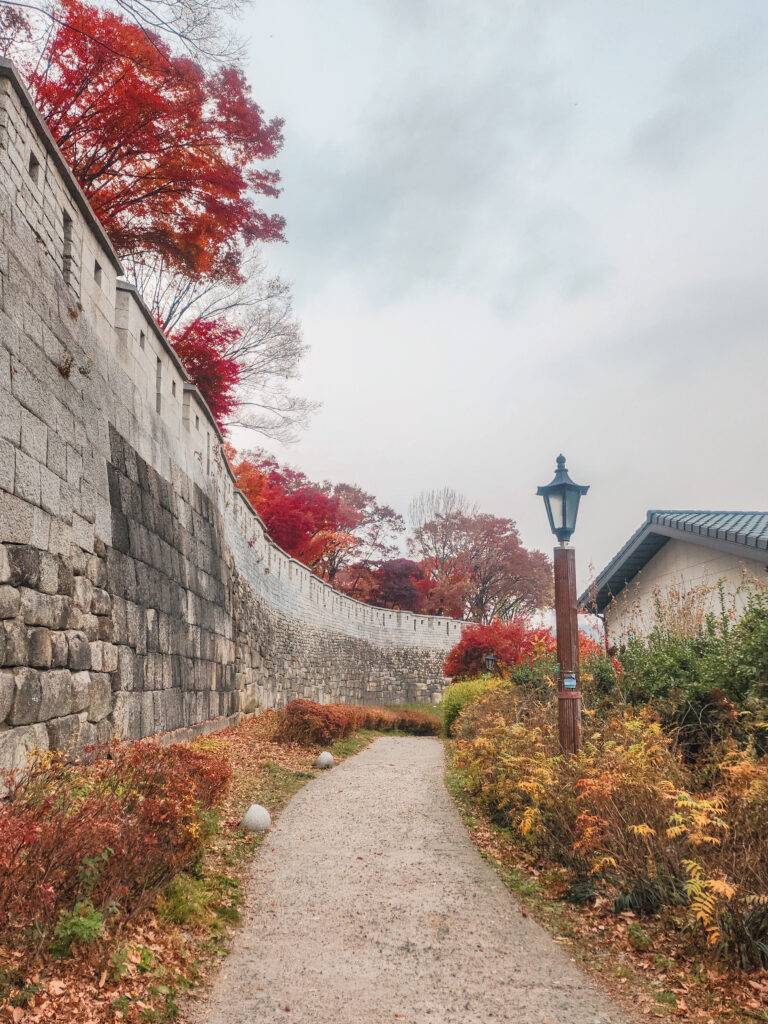
Take the opportunity to make photos of the view ! From up there, you will see a part of the sitter that has been preserved. Continue straight ahead to reach the maximum height. It’s a little walk that is a bit physical but worth the effort, between the fortress that you will walk along on your right and the view on your left, it’s clearly a place not to be missed in Seoul.
Where to take a coffee break with a view?
On your left, you will have a whole bunch of absolutely adorable little cafes with a very beautiful view of the famous Namsan Tower. I particularly recommend two coffees for this:
- the Chaeg Goyangi or 책고양이 (= the cat book). The owner is very kind, and you will see many books about cats. It’s a little bit the theme of the establishment. You will be able to put yourself both inside and outside for the panorama.
- the Gaeppul 개뿔 cafe, which has a strongly similar view. This place was seen recently in the drama Unknow Seoul.
Note that cafes open quite late (rarely before 10 AM) in Korea. On the other hand, they close late, often between 9 PM and 11 PM.
Hansung district and Seongbukcheon river
It’s time to go back down towards Hansung University to visit a less known part of the capital but just as pleasant, and largely less frequented. From this stop, you can walk along a small river, which you can do if you feel like being a bit quiet.
I recommend a pastry address in the surroundings, Isle bakery, which offers homemade cakes like vanilla and strawberry cakes, as well as cupcakes. A small café with a lovely view of the river.
Hyehwa (musical theater district)
Then take the metro back to Hyehwa, a neighborhood known for its theaters and musicals. It is still quite little frequented by tourists, but clearly worth the detour. It is not uncommon in the neighborhood to encounter more or less well-known actors from musicals, so open your eyes if you are an amateur.
There, you will be able to taste many different types of food. I don’t have a restaurant address to recommend to you in particular, except maybe to taste one of the other specialties, Chinese of origin, jjajangmyeon, 짜장면. To do this, go to a restaurant located below called 홍콩반점 0410.
Discover the traditional Seoul and its cultural highlights: third day 📍
A route to visit traditional Seoul, centered on palaces, historic neighborhoods and Korean culture.
⚠️ Avoid on Monday, the closing day of certain palaces.
Changdeokgung Palace and the Secret Garden
⏰ Open until 17:30 or 18:30 depending on the seasons. Entry costs 3000 won.
Changdeokgung is one of the main palaces in Seoul. Although it is smaller than Gyeongbokgung, I highly recommend you to visit it! Expect quite a bit of tourist traffic. This palace is superb, it was listed as a UNESCO World Heritage Site in 1997. It also served as the setting for the cult drama 대장금 (= ‘a jewel in the palace’).
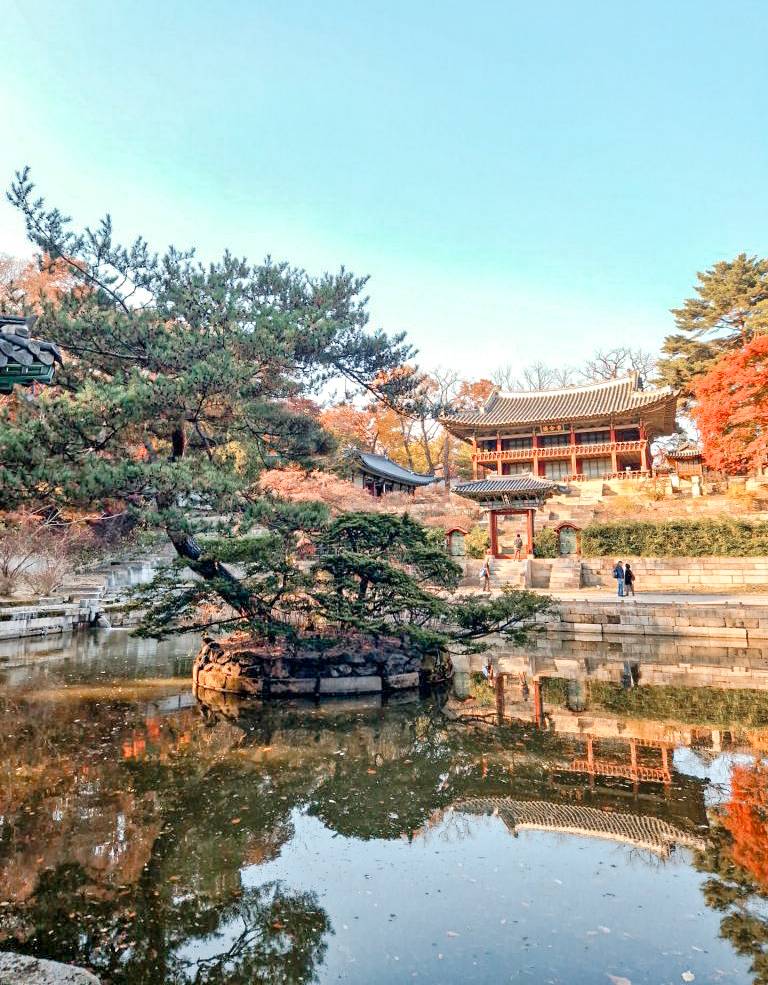
The part of the palace housing the secret garden is magnificent in spring for the blooming of the cherry trees, and in autumn. The rest of the year, especially in winter, some places are not accessible because they are dangerous due to the weather. The Secret Garden is accessible only on a guided tour, it will cost you 5000 won in addition to the entrance ticket. The guided tours in English are at 10:30, 11:30, 14:30, and 15:30 (duration: 1h 30). If you miss one of these slots, you will not be able to access the garden.
Changgyeonggung Palace
⏰ Open until 9 PM. Closed on Monday. Entry costs 1,000 won.
Right next door, I also recommend the Changgyeonggung Palace, slightly less frequented. This one has the particularity of having a lake and a kind of greenhouse in its more remote part. I visited it several times just like the previous one, every time by day, but I think that at night the atmosphere must be quite incredible.
Count 1h to 1h30 of visit.


Lunch and visit of the Anguk neighborhood
Anguk is not a place per se, but an area, which gave its name to the metro stop. The atmosphere is similar to that of Bukchon village, I like it a lot! Stroll through the small streets to discover their charm.
I particularly recommend you a restaurant that opened in 2025 and to which I went twice: Hoisik. Located in an alley, they serve a soup with noodles and chicken and also samgyetang, Korean dish consisting of a soup with ginseng chicken and cooked rice. Personally, I prefer the first option! Once again, you won’t go broke, count 12,000 won for a dish ( 7€).
Generally, restaurants are not very expensive in Korea, you can easily eat a meal between 5 to 8 € per person. Otherwise, the previous restaurant’s next door neighbor is an absolutely incredible ramen! If you want an immersive experience, don’t hesitate to go there. The order is made on a terminal and you wait for us to call your number. If you are a foreigner, someone will come to pick you up. Here, all the staff then begins to welcome you by speaking very loudly, it’s quite surprising.
Rue Gyedong-gil
Stroll in the Gyedong-gil street, hiding nuggets:
- The beautiful gift shop 디아트 (The art).
- The vintage shop Goodbuying Club: it hosted the filming of Kdrama True beauty
- The traditional Onion coffee: be careful there is often a queue. You will be able to drink carrot juice from the island of Jeju, in a hanok, sometimes sitting on the ground on cushions like the Koreans.
Temple Jogyesa
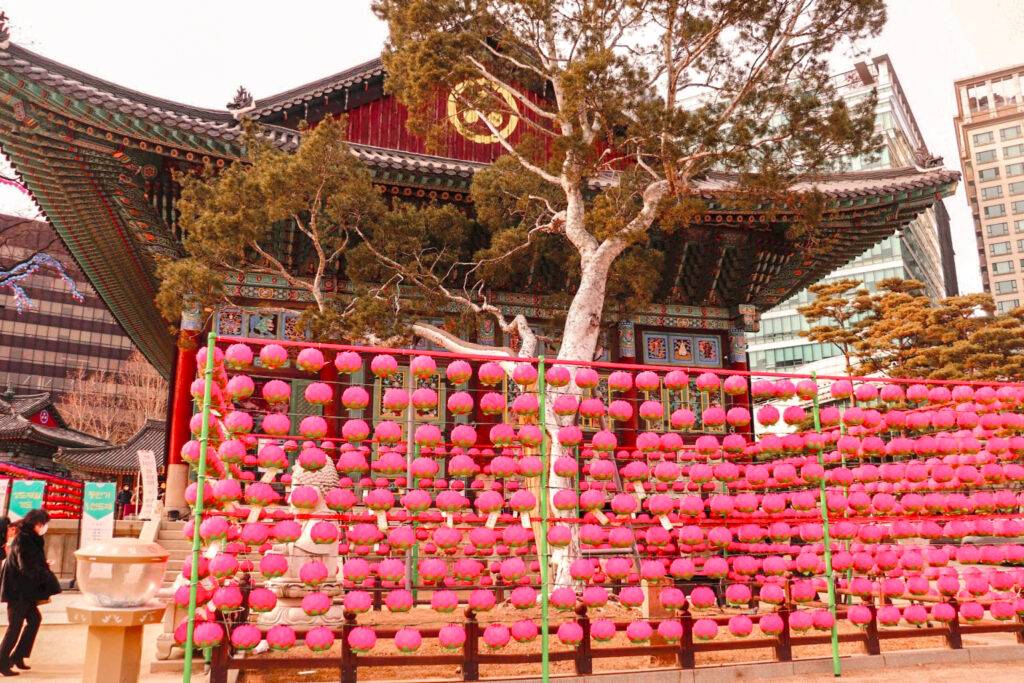
The Jogyesa Temple is one of the most well-known in the city, it is emblematic in Seoul. I am obliged to recommend it to you. He offers a “stay temple”, that is to say the possibility of living as monks for one day or two. The place is relatively small, but still nicely decorated.
Insa-dong Street
Not even 5 minutes walk from Jogyesa, you will pass in the busy street of Insa- Dong. It is clearly the landmark for tourists in search of traditional souvenirs and an immersive experience. I am not an expert in shops on this street, but I know that some are tourist traps.
For my part, I went there rather to go to art galleries, usually free, and sometimes without employees. There are many cameras in Korea and the country is very secure: which means that there isn’t always someone in the shops.
Finally, I highly recommend a traditional tea room in which I have been twice (New old tea shop) and where the owner will try to type the discussion. She is adorable and the place is way too pretty, far from the hubbub of the main street. There you will find traditional teas, as well as purely Korean cakes.
The district of Ikseon-Dong
A neighborhood located not even 10 minutes from Insa- Dong, in which you will also find all small traditional streets. The area is not very large, but it is quite touristy.
Mostly, restaurants and all types of cafés more incredible than the others have invaded Ikseon-Dong. Some don’t hesitate to queue for more than an hour before opening to be sure they have room. For example, you could find a coffee with railway rails, or a coffee in which it rains. It may leave you speechless, but welcome to Korea!
Walk by the river Cheonggyecheon
After the Han River that bisects the city in its middle, Cheonggyecheon River is the second most well-known river in Seoul.
Officially laid out since 2005, it is possible to walk on both sides of the banks for more than 10 km. In winter, the famous lantern festival takes place there, and from summer until autumn, there is also an outdoor library (even offering titles in foreign languages).
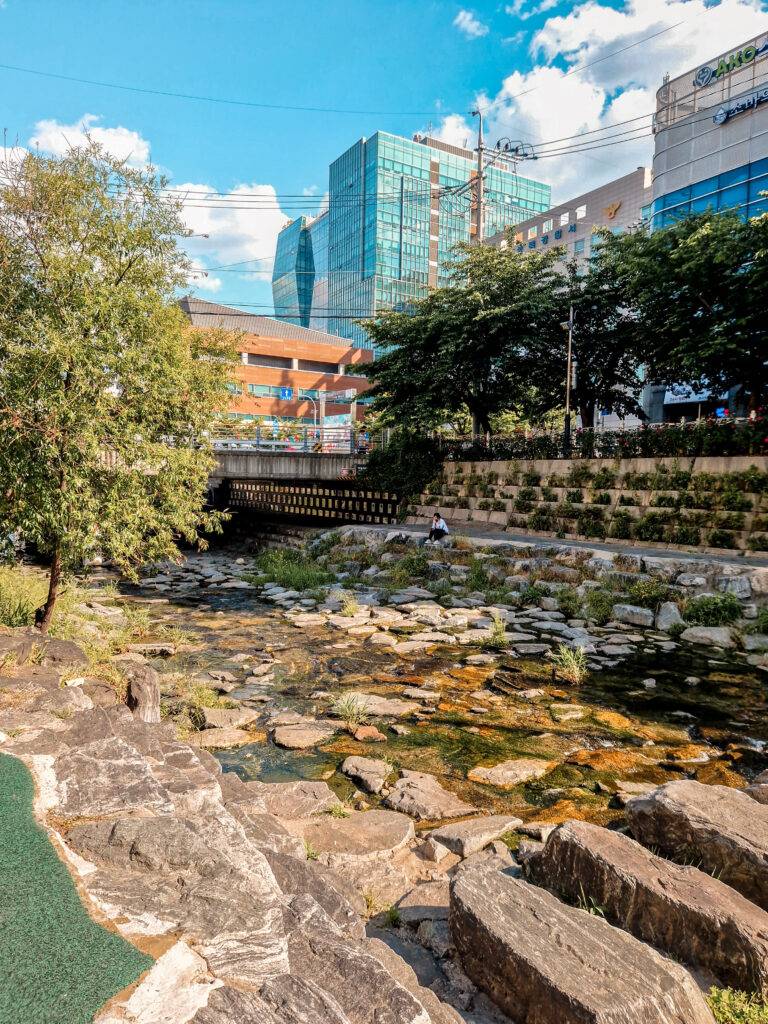
The Cheonggyecheon River is a must-see place in Seoul, where you can sit down to read, chat with friends, or just relax for a moment. As pleasant during the day as in the evening, I highly recommend to do a few kilometers along the water. You will even be able to see some fish.
The largest market in Seoul: Gwangjang market
The largest market in Seoul: Gwangjang market. Widely regarded as the largest and most important market in the whole city, I strongly invite you to go there if you want to discover the local gastronomy, good and not expensive. Of course the world is at the rendezvous, foreigner as well as Korean, but you will not regret your visit to Gwangjang.
Some stands have even become cult and thanks to a Netflix series, you won’t be able to miss them, as the mention of the American platform is highlighted.
📌 What to eat at the Gwangjang market?


Here is the Korean street food that I advise you to taste :
- The gimbap, one of the most well-known and commonly consumed Korean specialties. These are rolls composed of white rice, sesame oil, a nori seaweed. Generally, they are filled with vegetables, meat, or tuna. That said, as many varieties exist as there are inhabitants. In short, it looks like a big maki.
- Tteokbokkis
- The pajeon, a kind of pancake composed of green onions and egg.
- Mandu
- Hotteok (my little sweet pleasure). These are kinds of pancakes, usually stuffed with honey, sugar, or cinnamon. Quite fat but so good and comforting!
Noraebang (Korean karaoke)
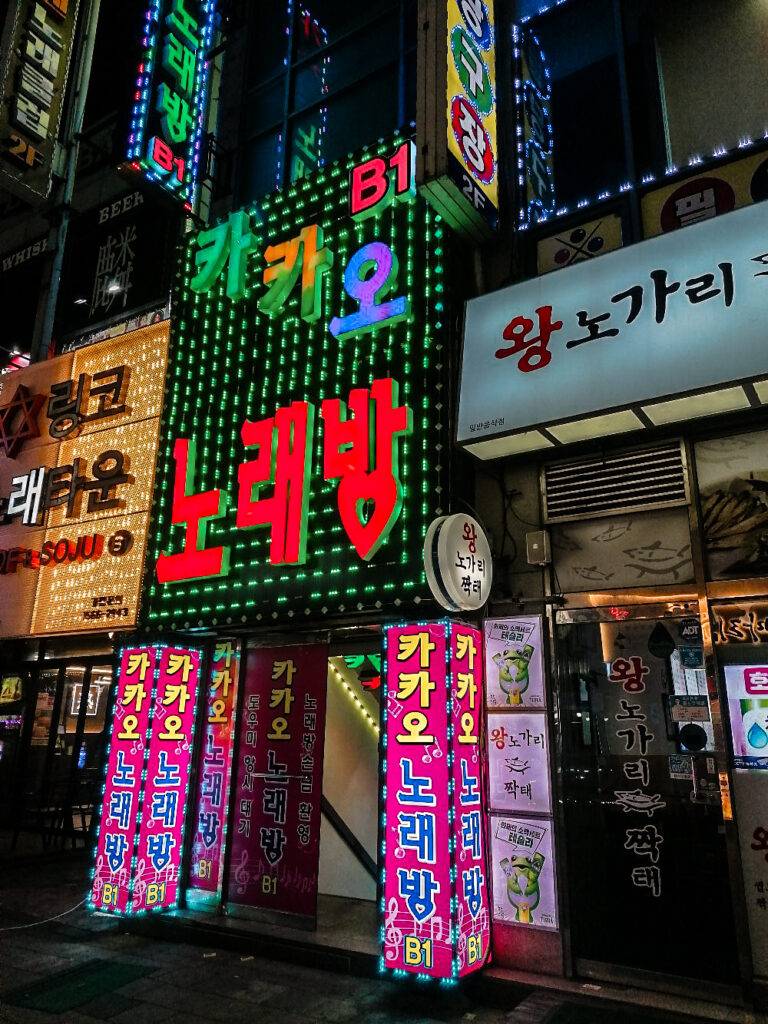
To end the day: head on a noraebang (노래방 = «sing with a piece»). The karaokés are very numerous in Korea. They are quite affordable, very often well equipped and large.
I recommend one to you: the Alpha karaoke. No one works there but you can book your room on a digital terminal. Generally, you pay by the number of songs or by the hour, count 9,000 won (5€) for 1 hour.
Visiting the must-sees of modern Seoul: day four 📍
Olympic Park
Olympic Park is an absolutely gigantic park located in the southern part of the city, not far from the famous Lotte Tower. To give you an idea of its size, there are several concert halls, museums, as well as a swimming pool.
Don’t hesitate to sink inside, to be closer to nature. The Olympic Park is a place not to be missed in Seoul, especially in autumn, to see the magnificent colors. The part towards the lake is really very nice to see, and do not hesitate to climb a little, you will have a pretty view of the Lotte Tower and the neighborhood.


⏱️ Count at least 2 hours on site.
The highest tower in South Korea: Lotte tower
It is of course mandatory to go see the highest tower in the country, inaugurated in 2017. The Lotte Tower culminates at 550 m high.
If you don’t like everything that is modern too much, you can skip this step. No need to go inside, which is mostly composed of a shopping center.
The Lotte Tower Mall
If you wish to go shopping in South Korea, I can recommend the mall inside the Lotte Tower in Seoul. You will mainly have international brands like Zara, H&M or Uniqlo, but also typically Korean brands such as Gentle Monster, Jaju, Spao or 8 seconds. However, for a more typical experience, I rather recommend the Hongdae or Seongsu district for shopping made in Korea.
The part located directly under the tower is rather reserved for a luxury shopping center where you can find all the international brands.
Walk at Seokchon lake and amusement park
Beyond themodern architecture of the Lotte Tower and shopping, I really advise you to go to this neighborhood to discover the Seokchon lake, adjacent to the tower. You will be able to walk around it in a maximum of 30 minutes.
A very well-known amusement park , the Lotte World, is located on the lake.
If you’re visiting Seoul at the cherry blossom season, this place is a must-see ! On my side, I did it in all seasons. It is particularly pleasant in spring indeed for the beauty of nature, but also in autumn, with magnificent colors.


Lunch in the Songpa district
Then leave to join Songpa, neighborhood located under the lake when looking at the map. There, everything evolves very quickly. The neighborhood has become very expensive in terms of real estate and offers lots of really incredible small restaurants/cafes. A perfect place for a lunch break!
Big recommendation for the restaurant Solsot Songridan Gil Jeom (솔솥 솔리단길점), specializing in a dish composed of rice with meat, cooked in a traditional dish. Delicious and very nutritious.
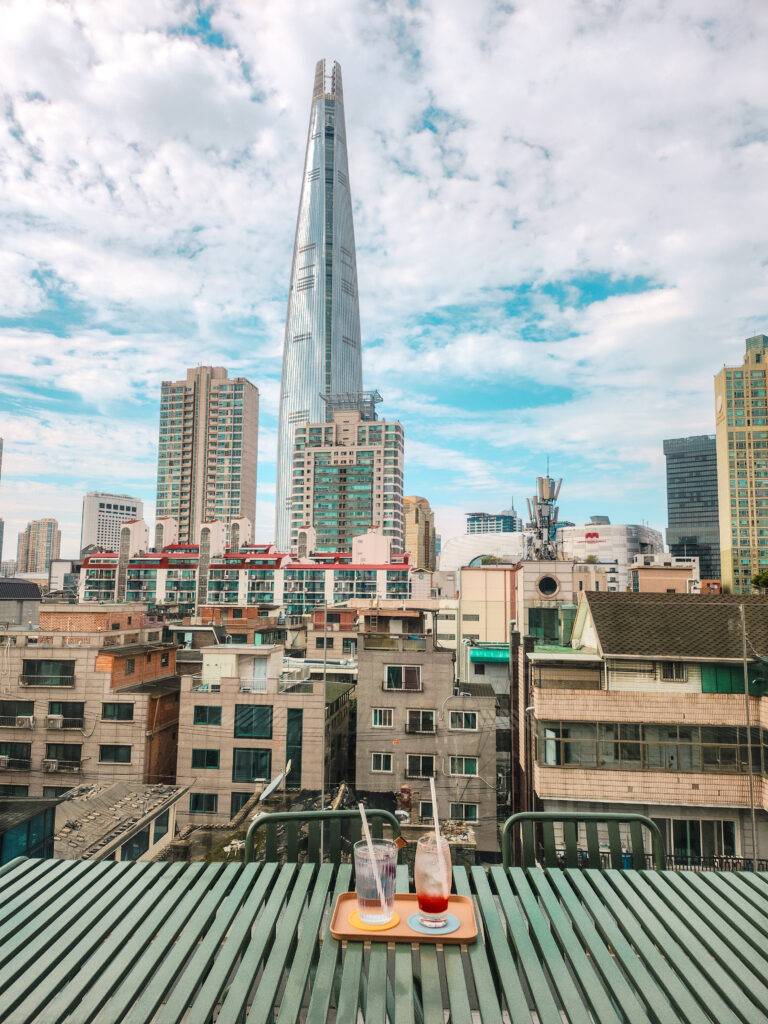
For a coffee with a magnificent view of the Lotte Tower, I highly recommend Cieultri. Its outdoor terrace gives an absolutely incredible view. The prices are not more expensive than elsewhere!
Seongsu district
This is where I lived during my last 3-month stay in Korea. 2 years ago, the neighborhood was not as trendy nor even as crowded, but since 2025, it is clearly there that you must go if you want to consume.
The Seongsu neighborhood hosts an incalculable number of clothing stores, cafes, restaurants, skincare. The famous pop-up stores have all opened their doors quickly in Seongsu!
Clearly the temple of overconsumption, if you are not there for that, skip this step and go directly to Seoul forest. Otherwise, stay a little longer, I will share with you some good addresses.


📌 My good shopping addresses in Seongsu
For skincare
For fans or curious about the Korean skincare, go to Olive Young exit 4 in Seongsu. A brand new gigantic store, built last year. You can clearly buy way too many Korean products, but believe me it’s worth it, the quality is really crazy, the prices are very affordable or even low (between 5 to 10€ for a serum, 1€ for a face mask, 8€ for a cream…). The offer is very diverse. Moreover, Olive Young systematically offers promotions on some of these products. During your stay, it is therefore worth visiting one of the chain’s stores several times to check the prices.
Vintage clothing and accessories
You can shop for pretty pieces in the many vintage shops in the Seongsu neighborhood. Reveal your inner star in the brand new, multi-storey eyewear store opened last December, Blue Elephant. The models are very stylish, really cheap, and the decor of the store is crazy.
Coffee shops
If you want to take a little break, I recommend in particular the cafes Frolla and Ddd. There are many cafes in the Seongsu neighborhood, I discovered a large number of them, but I think these two are among my favorites.
An unusual place in Seongsu
If you want to see a completely bewildering building, go to Haus Nowhere, a place inaugurated in 2025. It is very impressive with a magnificent architecture. Haus Nowshere hosts the brands Gentle Monster, Tamburins, Nudake or even Atiissu. You will understand what Korean-style excessiveness is, with a completely crazy and unique concept.
The shopping street of the neighborhood
Don’t hesitate to stroll along the Yeonmujang-Gil, the main shopping street of the neighborhood where you will find shops such as Banila co (Korean brand all pink skincare and makeup), Adidas, Blue Elephant and pop-up stores of all kinds!
Nyu nyu, a Korean brand important quite a bit from China that is becoming more and more important, offers several shops just in the neighborhood. The prices are very low, and I bought some clothes that I am not unhappy with at all. If you need last-minute clothes, don’t hesitate to go there, for a few euros you will get a top or a shirt, and for a big ten euros you will get a vest!
Seoul Forest


After your shopping session (or not), a nature break will do you great good! Seoul Forest is an urban park located west of Seongsu, near the Seoul Forest and Ttukseom metro stops.
Opened in 2005, this park is very pleasant in all seasons. There is a small lake in the middle, a zoo, as well as a arboretum. I recommend a good hour and a half to stroll quietly. You can even picnic in the center of the Seoul Forest on the tables provided for this purpose.
Bordering the park just to the north, there is a popular street among Koreans called Coffee Street. As its name suggests, this street which is not very long yet, has seen a number of cafes rise quite incredibly. Don’t hesitate to look at social media to find good addresses with original decorations that are out of the ordinary.
📌 My good addresses at the Coffee Street, near the Seoul Forest
☕ On my side, I tested and approved the Plad Coffee over five floors. This cafe has a particularly successful decoration and a lovely outdoor terrace.
🥞 Otherwise, 5 to 7 offers fluffy pancakes, a dessert commonly found in Korea but which generally costs more than a dish. Count at least 15,000 to 20,000 won for the pancakes (€10).
🍪 If you are a cookie enthusiast, I recommend the Nook café.
🥖 And finally, if you want to eat a nice French baguette, you can go until 6 PM at the Seoul Baking Studio. A real bakery like in France, even if the prices are about double those of our country.
🎙 For K-Pop fans, right next door is the official SM agency shop: Kwangya. In the basement, it is not very big but you can find albums and merchandise from your favorite artists like Shinee, NCT, Aespa, Exo… the SM agency, for its part, is located in one of the buildings just at the top of the shop.
Ride at Ttukseom Han River Park or Yeouido Han River Park


The Han River separates the city for tens of kilometers. A symbol of Seoul, it will soon become the ballet theater of bus on water, a system on which the city has been working for more than a year now.
Many corners in Seoul have been set up to enjoy the surroundings of the Hanriver, but my favorites remain the Ttukseom Han Riverside, not far from where you will be previously if you follow my itinerary. I also like the Yeouido Han River park, although it is more popular than Ttukseom.
Finally, do not miss the Banpo Bridge, one of the most important bridges in Seoul. Every evening from April to October, he sees himself adorned with a rainbow of water jets during shows…
Visiting Seoul and its modern architecture: last day 📍
The station district of Seoul
Let’s start this beautiful last day with a visit to the district of Seoul railway station, with the old building, now an exhibition center, and the modern train station.
The walk connecting Seoullo to Myengdong (at the back of the station) is very nice. It is short, but you will have a very nice view.
Afterwards, direction Knit café, a nice little café located near businesses with adapted hours. It opens early and closes early every day. I particularly recommend their financiers and their hot chocolate, first step before the ascent to Namsan Tower.
The Namsan tower and its park
Symbol of the city, recently renamed N Seoul Tower but which everyone still calls Namsan Tower, it overlooks Seoul and is visible from many even remote neighborhoods. Culminating at 236 meters, relatively small for a capital city, it was built in 1971. It was the first radio antenna in South Korea, allowing channels such as KBS, MBC, or SBS to receive signal.
The peculiarity of this tower is that you can know the level of air pollution, depending on the color it emits at night. Red means air is bad, green acceptable and blue means air is of good quality, which is quite rare unfortunately.


The Namsan Tower is clearly one of the mandatory steps during a trip to Seoul, whether during the day or in the evening. Several solutions are available to you if you wish to reach the foot of the tower:
- On foot from the Namsan park. Count 1h.
- Bus ride away.
I did both, and it all depends on your desires, your physical condition and obviously the weather. The climb is particularly pleasant, especially in terms of the beauty of nature in spring and autumn. But frankly, it is appreciable all year round to go visit it.
The village of Namsan Gol
As the name suggests, Namsan Gol is located just below the tower of the same name. This small village has remained in its original state, it immerses you in the Korea of the time. Before entering your right you can even find a temple.
In addition to the small village, there is a whole garden housing a memorial with foreign representatives like Jacques Chirac. Regularly, festivals are organized there, and during my last visit I attended a rehearsal of pansori for a show, an art 100% Korean that combines singing, instruments and body movements.
The visit to the village of Namsan Gol is very pleasant, a bit touristy but not too much, a place I highly recommend!
Myeongdong
By getting off by bus or on foot, you can reach the unmissable district of Myeongdong, which is quite busy. Notably known for its street food market, it also hosts many international and Korean clothing stores, restaurants, and even the Chinese embassy.
Myeongdong is nice to visit day and night, but expect to see a lot of people. Reason why I admit avoiding the neighborhood… But I think that for a first stay, going there at least an hour or two to see the atmosphere is cool to do.
The Namdaemun market
Don’t miss by one of the other well-known markets in Seoul: Namdaemun. It is smaller than Gwangjang and rather frequented by the locals.
In Myeongdong you will find, among other things, a café entirely dedicated to Hello Kitty, a huge restaurant offering the famous kalkgugsu, the Myeongdong Gyoza, particularly known for its gyozas, and its kalkgugsu. This new restaurant, located at exit 8 of the metro, is huge. The dish costs around €7. A very popular address for Koreans and tourists.
If you want to bring small gifts including socks, go for a walk in the gallery leading to the metro of Myeong Dong. Know that in Korea, the interior of subway stations are very lively, often with cafes, corners to eat, or even small shops. At some stations, we don’t really know where to look, like at Gangnam or Express bus terminal.
Practical information: organize your trip to Seoul best 🤩
What is the best time to visit Seoul?
The two seasons that I recommend you to visit Seoul are spring and autumn. In the spring, the blooming of the cherry trees in bloom gives a completely different look to the must-see places in the city. Autumn also offers wonderful colours on the trees. On the temperature side, these two periods are favorable for a pleasant trip.
On the other hand, I strongly advise against summer and winter. During the hottest months of the year, a big city like Seoul has a stifling climate and mind-boggling humidity, with air pollution exceeding the rest of the year. Moreover, in summer, the rainy season is in full swing. Finally, the winter is harsh, with temperatures falling to -20°C.
How to get around Seoul?
South Korea is far ahead of public transport. The network is well developed and impressive! Seoul has 23 subway lines and 768 stations. For the bus, the city has 400 lines and 6200 stops.
Getting around by public transport in Seoul is a convenient and economical solution. I give you all my advice to not get lost.
Take the bus and subway in Seoul
To take the Seoulite transport network, you will need:
1) The T Money card
The T Money is a payment card found in convenient stores (supermarkets generally open 24/7 like GS 25, 7 Eleven, CU and Emart 24). This card is valid in ALL KOREA. It costs between 2,500 to 4,000 won (less than €3) and you can recharge it directly after buying it in the supermarket. To do this, take out the money you wish to put in it, I advise planning 40,000 won (€23) for two weeks and a voucher of 60,000 won (€35) for 3 weeks, if you want to use only the T Money to take the transport.
🎫 How to get the T Money Card?
Tell the employee: 충전해주세요 (Chungjeonhae juseyo). This means that you want to charge your card for the determined amount. You can then recharge this card in all the metro stations, if you don’t have any more money before the end of your stay.
💡 How to recharge your T Money Card?
In metro stations or at convenience stores. More and more stations are finally equipping themselves with T Money charging stations with credit card, but it is not yet very common, so I strongly encourage you to always have cash on you for the recharge.
2) The Climate Card
The Climate Card – a companion climate card – is available in the metro information centers or the famous grocery stores mentioned above, say you want the 기후 동행 카드 or show them a photo. It is ONLY valid in Seoul and the surrounding cities served by metro lines (exceptions with certain lines, I advise following Seoul City on Instagram which shares with each new addition of a city served by the Climate Card).
⚠️ You will therefore necessarily need the T Money for the rest of the country.
💡 How to use the Climate Card?
Once you are in possession of the grail (believe me, this thing is great), go to a terminal in front of the metro gates (the table is in English notably so no worries), and select the transport package you want.
You can take a daily package (5000 won, which is within 3€, paid for in just over three trips), two days for 8000 won, one week for 20 000, or a little more than ten euros, and even in the month. In short, everything has finally been done to facilitate and reduce transport costs in the city of Seoul and its metropolis.
What are the differences between the Climate Card and the T Money?
In summary, The T Money is indispensable. It is the basic transport card in South Korea. It allows you to pay for all trips individually (bus, metro, sometimes taxis) anywhere in the country. The disadvantage of this card is that you always have to calculate its balance to be sure of having enough money on it. If you plan to travel to South Korea outside of Seoul, you MUST have it.
The Climate Card is a complementary transport card, designed for stays in Seoul. It works as an unlimited package for a given duration (1 day, 2 days, 7 days, etc.), but only in Seoul and certain cities of its metropolis. It does not therefore replace the T Money, because it does not work either in the rest of the country or on certain specific routes.
💡 Good to know: even with a Climate Card, you must have a T Money loaded on you, especially for trips not included or if you leave the covered area.
From when is the Climate Card profitable?
Here is a clear comparison table to know if it’s worth getting the Climate Card for your 5 days in Seoul.
| Type of card | Price | Profitability |
|---|---|---|
| T Money (trip to the unit) | 1 400 to 1 600 won / trip | – |
| Climate Card – 1 day | 5 000 won | ≈ ≥ 4-5 trips |
| Climate Card – 2 days | 8 000 won | ≈ ≥ 3-4 trips / day |
| Climate Card – 3 days | 10 000 won | ≈ ≥ 3 trips / day |
| Climate Card – 5 days | 15 000 won | ≈ ≥ 3 trips / day |
| Climate Card – 7 days | 20 000 won | ≈ ≥ 2-3 trips / day |
| Climate Card – 30 days | 62 000 to 65 000 won | ≈ ≥ 2 trips / day |
Where to have a drink in Seoul?
If you wish to have a drink, I recommend the somewhat select bar Jusindang 주신당 present in several neighborhoods of the city, whose main theme is the Chinese zodiac signs. You will be able to order a ‘monkey’ or ‘cow’ cocktail for around 18000 won, almost €10. This bar is expensive for Seoul but it’s one of my favorites. There are also more classic cocktails with or without alcohol, boards or dishes to snack and eat. The staff is young and very nice!
The shops to discover in Seoul
I highly recommend you to take a tour in the Daiso store chain, kind of Action/Foir searches hyper clean, offering everything and anything. The prices are very low and the quality frankly not bad. Daiso is known by all tourists and Koreans who wish to buy things for cooking, SDB (with too cute sponges), skincare, tights for winter… Basically, everything can be found at Daiso and it’s a very convenient store. There is a large one at exit 4 of Hongdae.
Regarding clothing, international brands like H&M, Zara, Uniqlo, Levis are present in Korea, but many others cannot be found. For the Korean brands, I advise you: Spao, Uniqlo, Nyu Nyu.
Note that at Adidas, sneakers are on average 20 to 30€ cheaper than in France.
The shops in the district of Hongdae
The small shops in Hongdae are attractive and pretty as well, just like those in Seongsu. If you prefer vintage, Hongdae, Yeonnam-dong, Seongsu and Konkuk are really the places where you will find your happiness. For luxury, the prices are at the same price as in France or even higher. But if you want, it’s towards Gangnam, Apgujeong, Sinsa, in the mall of the Lotte tower, Hannam-dong…
For other general advice on South Korea, I invite you to meet me in my article «2-week itinerary in South Korea». I am detailing for you the places not to be missed for a first trip, but also everything I learned during my different stays to organize themselves as best as possible!
I hope this article has helped you know what to do in Seoul and organize your visit to this amazing city. Do not hesitate to ask me any questions in the comments of the article and to consult my other guides on South Korea to extend your stay.
to go further
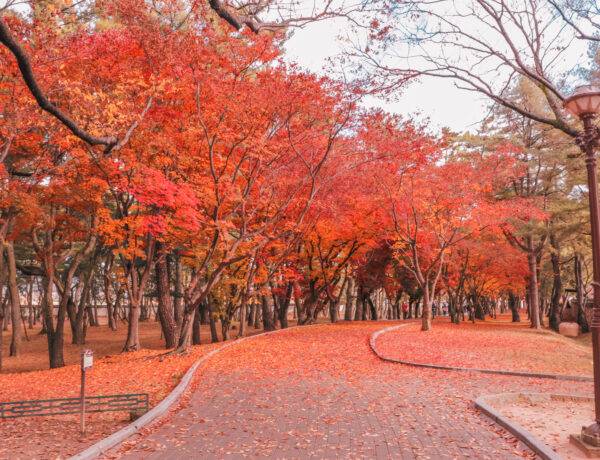
3-week itinerary in South Korea: what to do?
3-week itinerary in South Korea: what to visit to explore the country in depth…
23 April 2026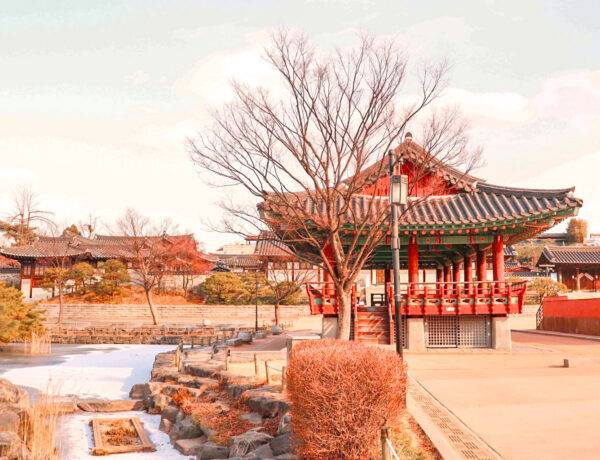
Visiting South Korea: 2-week itinerary
Visiting South Korea and its must-sees: 2-week itinerary South Korea is a country dear…
1 April 2026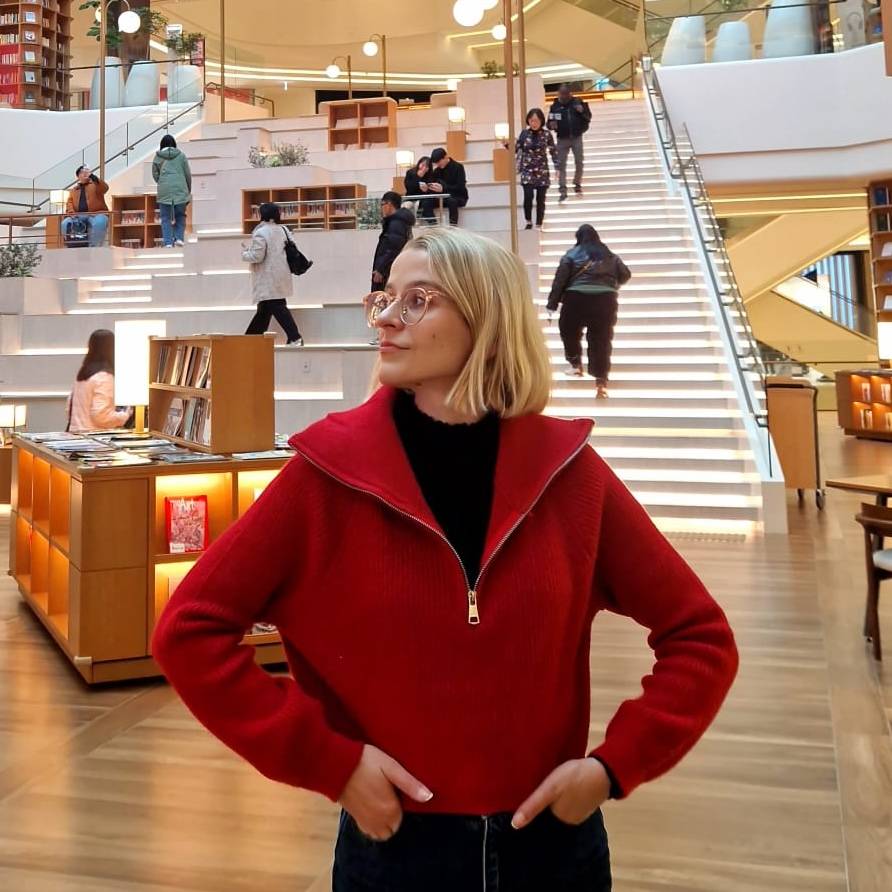
Laura, voyageuse dans l’âme et particulièrement amoureuse de l’Asie et de la Corée, j’y ai fait un PVT entre 2022 et 2023. Depuis, je retourne régulièrement dans ce pays qui a eu mon cœur et je partage à ce sujet sur mes réseaux.


No Comments