


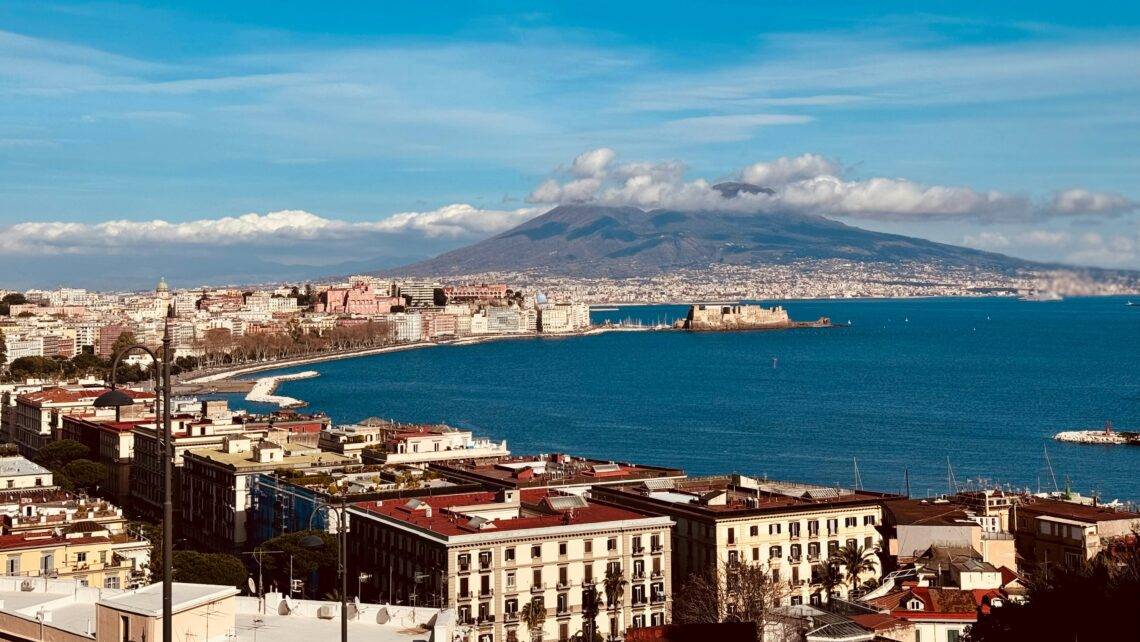
Capital of the Campania region, with the sea in front of it, Vesuvius as a backdrop, Naples is one of the oldest cities in Europe. Crossed by centuries of history, it keeps the imprint of the various empires which inhabited it. Its alleys in the historic center are classified as UNESCO World Heritage Sites. Its churches are laden with gold. Its museums are home to some of the most beautiful treasures of antiquity… So, if you like history, this city is for you!
But there are two sides to Naples. Some will see it as a open-air museum, and others as a noisy, dirty, and messy hell. It is true that the atmosphere there is very different from the calm and quiet of museums. Its historical remains stand very close to the exhaust pipes and horns. Its narrow streets are teeming with people and scooters. Moreover, it’s difficult to drive there in a vehicle without ending up in a traffic jam.
Is it worth visiting Naples?
This is a far cry from the bright, clean, and orderly cities of Tuscany. By the way, if you’re interested in this region, check out Aurélie’s article about her
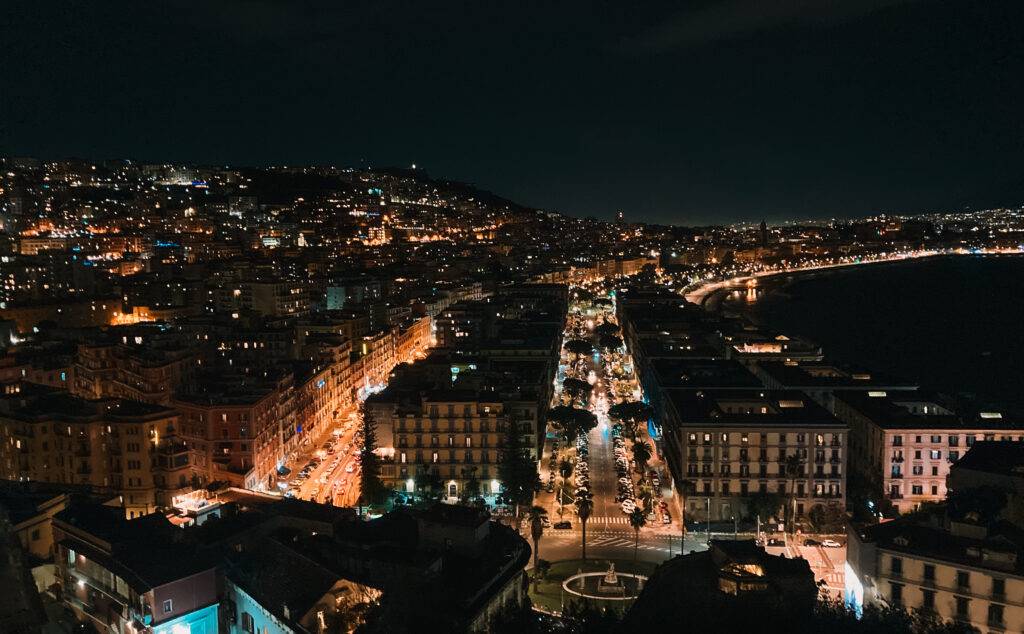
For my part, I went 3 days in Naples before going to do some
My honest opinion about the city of Naples 💬
I still decided to give him a second chance when I return in April. The weather was nice this time, and I knew what to expect. Mentally ready and willing to face the noise and chaos of Naples, the experience was very different. So don’t be surprised if you need a few days of adaptation before enjoying the city.
In particular, I really liked the very popular side of the city and the presence of religion as a backdrop. What particularly caught my attention: the votive edicole, or madonnelle. These are small niches dug directly into the walls of buildings, alleys, or church facades.
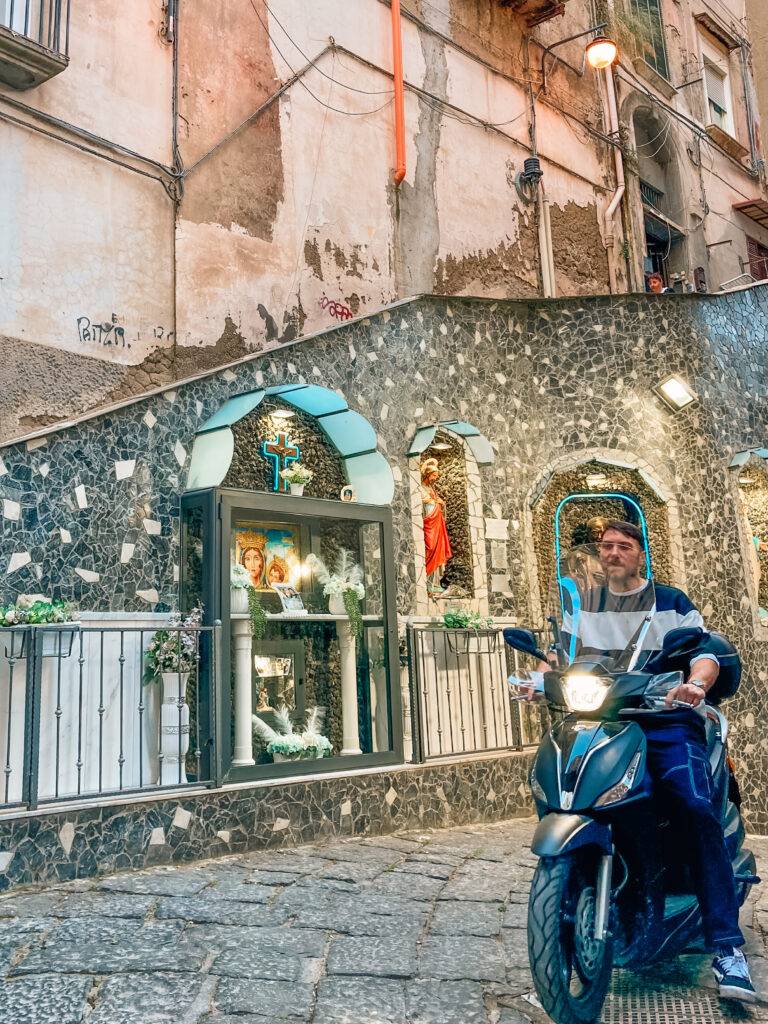
You will come across some very often in the different neighborhoods. In general, the narrower, older and more popular the street, the more likely it is to be found… So keep an eye out! They usually house a statue or an image of the Virgin or a saint. In front are candles, flowers, and sometimes photos. They are maintained daily by the residents of the neighborhood. Naples is the world’s capital, with more than 2,000 registered in the streets of the city. At the time, they were used to illuminate the alleys at night and protect the neighborhood. Today, they are an integral part of street life.
Map of the program to visit Naples in 3 days
In this article, I’m going to suggest a 3-day itinerary to visit Naples, combining history, culture, and of course, gastronomy. Italian cities are as much a matter of the eyes as they are of the taste buds! 😋
Here’s your program summary on a card that you can keep on your phone:
DAY 1—Spanish neighborhoods by the sea
The Spanish Districts – The Spanish Quarters 📍
It’s probably one of the most mythical places in Naples. The Spanish quarters are named after the 16th century. They were built with the aim of accommodating the Spanish military garrisons responsible for monitoring the Neapolitan population.
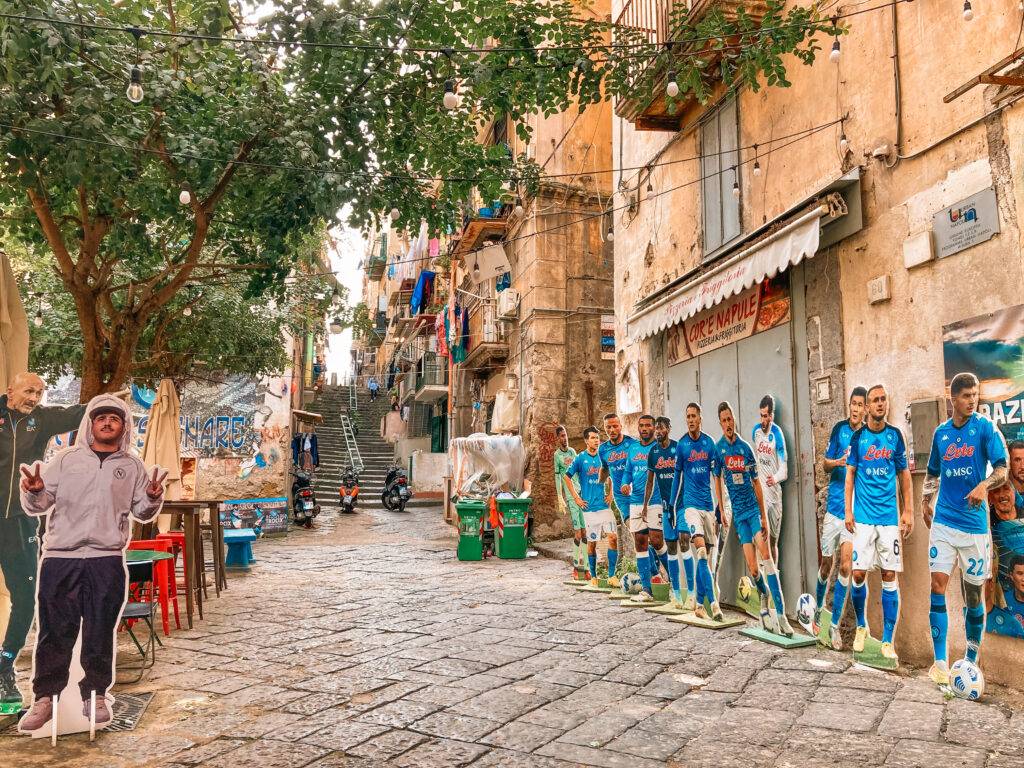
They consist of small narrow, sloping streets. Some streets are even inaccessible by car.
Don’t hesitate to leave the main road and head down the perpendicular alleys. That’s where everything really happens. Personally, I loved wandering there without a specific purpose. You are immediately transported into Neapolitan life and culture.


You will see laundry hanging between buildings, scooters slaloming between tourists, old people sitting on their doorstep…
Neapolitan street food 🍕
As you stroll through the Spanish quarters, you will feel the smell of coffee and fried food, typical of the city of Naples. Indeed, a large part of the Neapolitan street food is fried! And it is in this neighborhood that you will find the largest selection. Generations of families have been running the same stalls for decades.
I advise you to take takeout from one of the stalls, and to continue your walk, a specialty fried by hand.
Some of the most popular are:
- La pizza fritta : a fried turnover stuffed with ricotta, salami, and pepper, which is undoubtedly the queen of Neapolitan frying.
- The cuoppo di mare or di terra – a paper cone filled with fried fish and seafood for the sea version, or kibble and doughnuts for the earth version.
- Les crocchè : fried potato croquettes, often flavored with parsley and pepper.
Be careful, it’s bold!
Would you like to learn everything about Neapolitan gastronomy? Book your cooking class 🔗 to be able to replicate the real Neapolitan pizza and tiramisu!
The mural Diego Armando Maradona 📍
You will probably notice many banners or tags in the streets of Spanish neighborhoods bearing the image of Diego Maradona. Know that there is also a wall painted in memory of the latter, located in the heart of the neighborhoods. This is one of the most famous murals in the city.


In Naples, Maradona is not just a footballer. It is a kind of secular saint, a quasi-religious figure who brought to the city its only two titles of champion of Italy, in the 80s. It almost looks like the locals worship him! The mural, painted shortly after his death in 2020, became a pilgrimage site. You will see lots of ex-voto deposited by the inhabitants such as balloons, football shirts, candles… The sacred and the profane mix and thus transform this simple wall into a true popular sanctuary.
Via Toledo 📍
Next, I recommend taking the Via Toledo, which marks the boundary between the old city and the Spanish districts. About 1.2 km long, it is the main commercial axis of the center of Naples. Pedestrian and lively at all hours, it’s the artery where everyone meets.
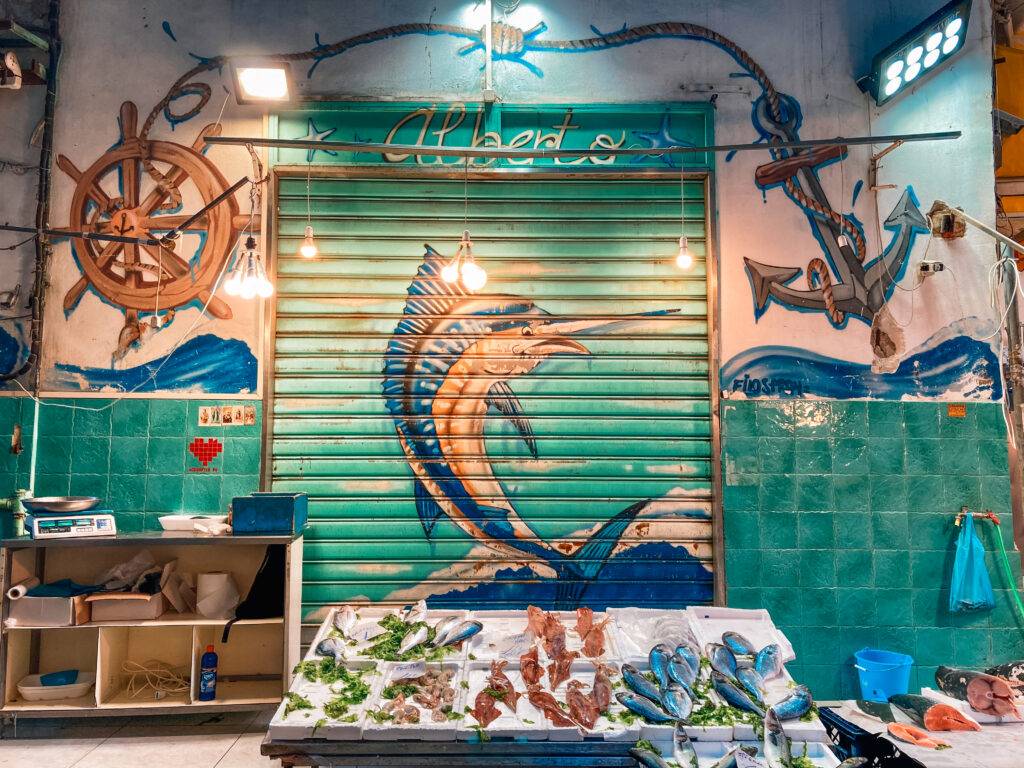
It’s a good time to take your lunch break and enjoy one of the many Neapolitan specialties in a trattoria or a pizzeria typical of the neighborhood! Whether your choice is the famous spaghetti alle vongole 🍝 (clam spaghetti) or the world-famous Neapolitan pizza 🍕, you won’t be disappointed.
💡 Good to know: Don’t miss Toledo Subway Station below. Created around the theme of water and light, it is a work of art in itself. It is part of the project “Stations d’art” of the Neapolitan metro: 14 stations decorated with more than 200 works by over 100 famous artists and architects.
The Galleria Umberto 📍
Continue along Via Toledo heading south, toward the seashore. You will first find the Galleria Umberto on your way. It is a shopping arcade covered with a monumental glass roof, decorated from walls to ceiling. But if the glass roof attracts all eyes, don’t forget to lower your eyes… Because the floor also deserves your attention. It is covered with a marble mosaic, which represents in its center a circle of the zodiac and the twelve signs of the zodiac.


Piazza del Plebiscito, the Royal Palace, and the Teatro San Carlo: the must-see monuments of Naples 📍
Then continue on to the monumental heart of Naples. Piazza del Plebiscito is one of the largest squares in Italy. The Palais Royal is just across the way. And next to it, the Teatro San Carlo is Europe’s oldest active opera house. These buildings are already very beautiful to see from the outside, but if you have time, don’t hesitate to take a look inside as well.
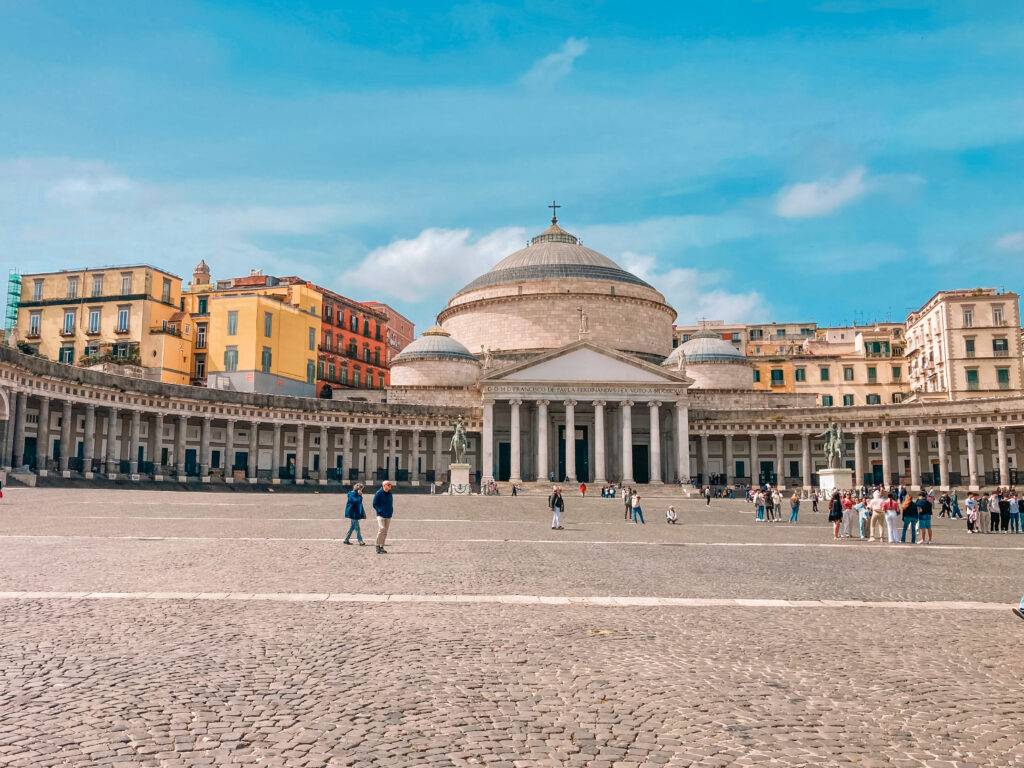
Walk along the Lungomare between Castel Nuovo and Castel dell’Ovo 📍
To end the day, I advise you to walk to Castel Nuovo. It is a medieval fortress built at the end of the 13th century. Its five round towers and its triumphal arch make it one of the most iconic landmarks in the city.
Then join the seashore and walk along it until you reach Castel dell’Ovo, resting on its rocky islet. It is the oldest fortress in Naples. Its name (“Castle of the egg” in French), comes from a medieval legend, according to which the poet Virgil would have hidden a magic egg in its foundations, whose destruction would lead to the fall of the city.
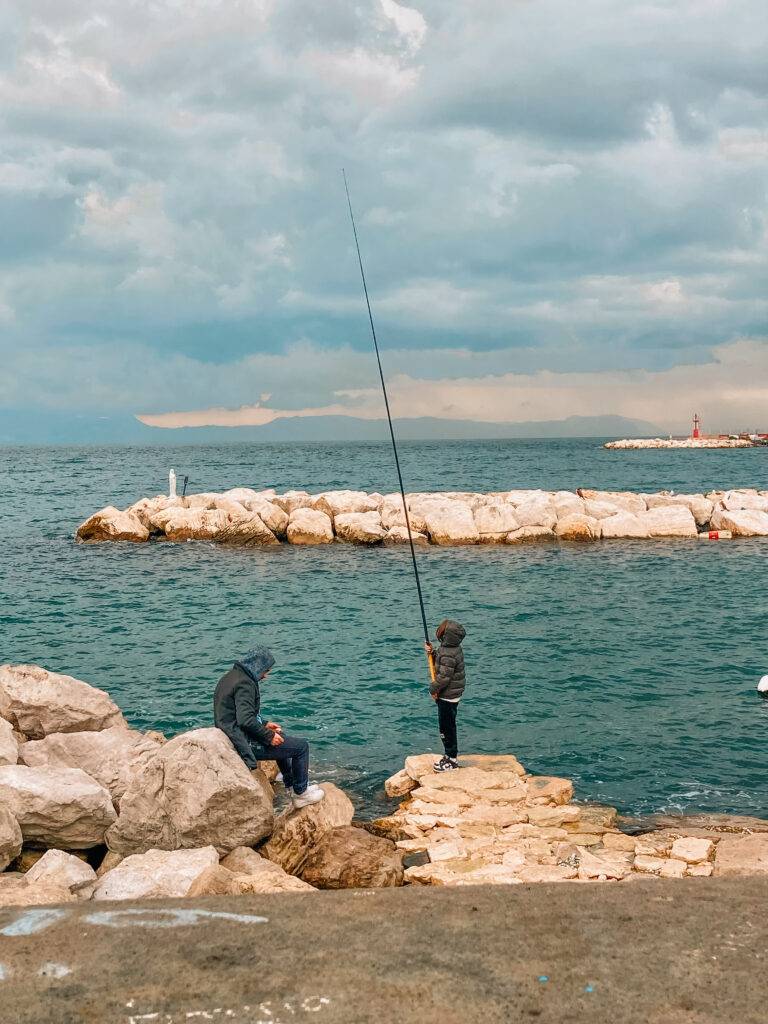
Finally, if the heart (and feet!) tells you so, you can then continue your way along the Lungomare Caracciolo. It’s the great walk along the Bay of Naples, with Mount Vesuvius in the background.
You can also stop on one of the many terraces by the sea to enjoy the sunset, a glass of wine in hand. 🤩
DAY 2—Museums and Historic Center of Naples
Would you like to discover the city of Naples with a guide? You can book a free guided tour (yes yes!) on this site (click here).
The MANN—National Archaeological Museum 📍
If you love museums and history, I recommend starting your day by visiting the Naples National Archaeological Museum. It is one of the largest in the world. Most of the treasures from Pompeii and Herculaneum are found there.
It’s dizzying to stand before these two thousand-year-old objects, perfectly preserved under the ashes of Vesuvius.
🎟️ Price: €26 per person with the audio guide. Booking by clicking here 👈
The Rione Sanità 📍
After the museum, I recommend you go for a quick tour in the neighborhood of Rione Sanità, which is only a 10-minute walk from the museum. Originally inhabited by the noble and wealthy families of the Neapolitan aristocracy, it has become one of the most popular and picturesque neighborhoods of Naples. It’s the authentic Naples, far from the tourist routes.
I advise you to visit the old palaces such as the Palazzo San Felice and the Palazzo dello Spagnolo. These are magnificent buildings dating from the 18th century. You can admire them by entering their courtyard, completely free of charge.
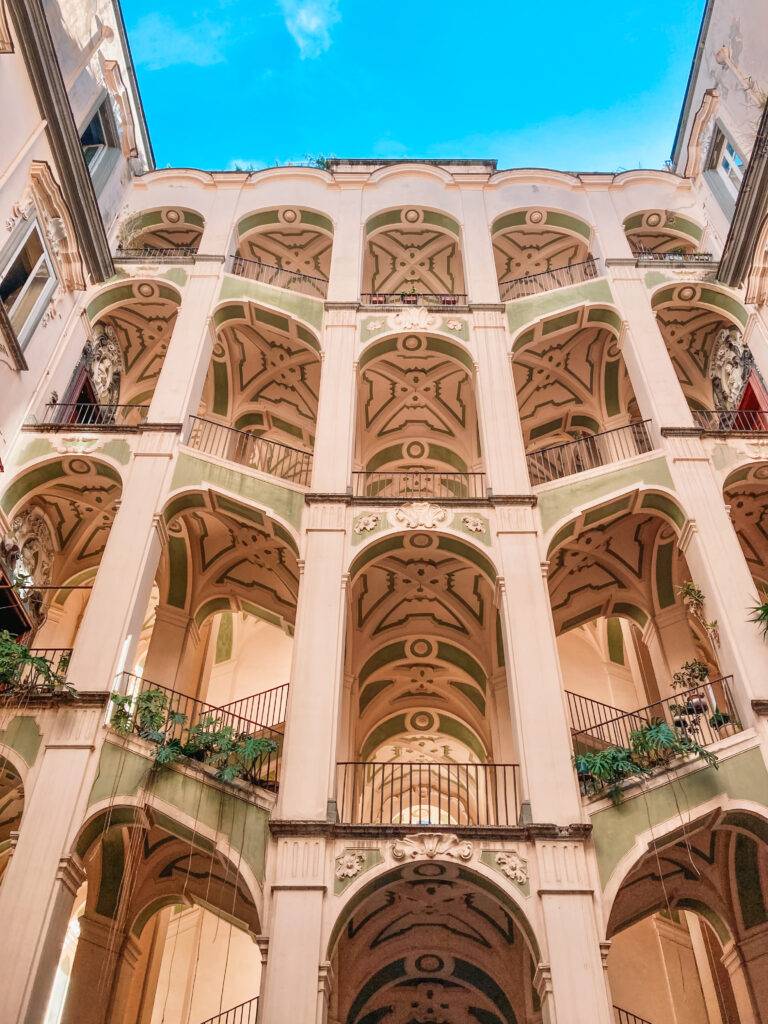
Personally, I really liked the atmosphere of Rione Sanità. It’s a neighborhood that is very lively with local life. You will see locals drinking coffee while reading their newspaper, young people sharing a glass of wine, families buying vegetables in the small market “Mercato dei Vergini”.


The Via Vergini has multiple choices of small cafes, wine bars, popular restaurants. It’s time to choose a terrace that makes you want to stop for a coffee or lunch break! ☕️
The district Pendino in the historic center 📍
For the second half of the day, I recommend focusing on the Pendino district, the historic center of Naples. It is one of the areas with the highest population density in European cities. It is characterized by its vicoli (alleys) paved with black lava stones, which will also remind you of the alleys of Spanish neighborhoods.
UNESCO World Heritage Site, you’ll travel through centuries of history. Historical buildings, baroque churches, popular markets, craftsmen’s workshops and typical restaurants are all found there.
The Duomo 📍
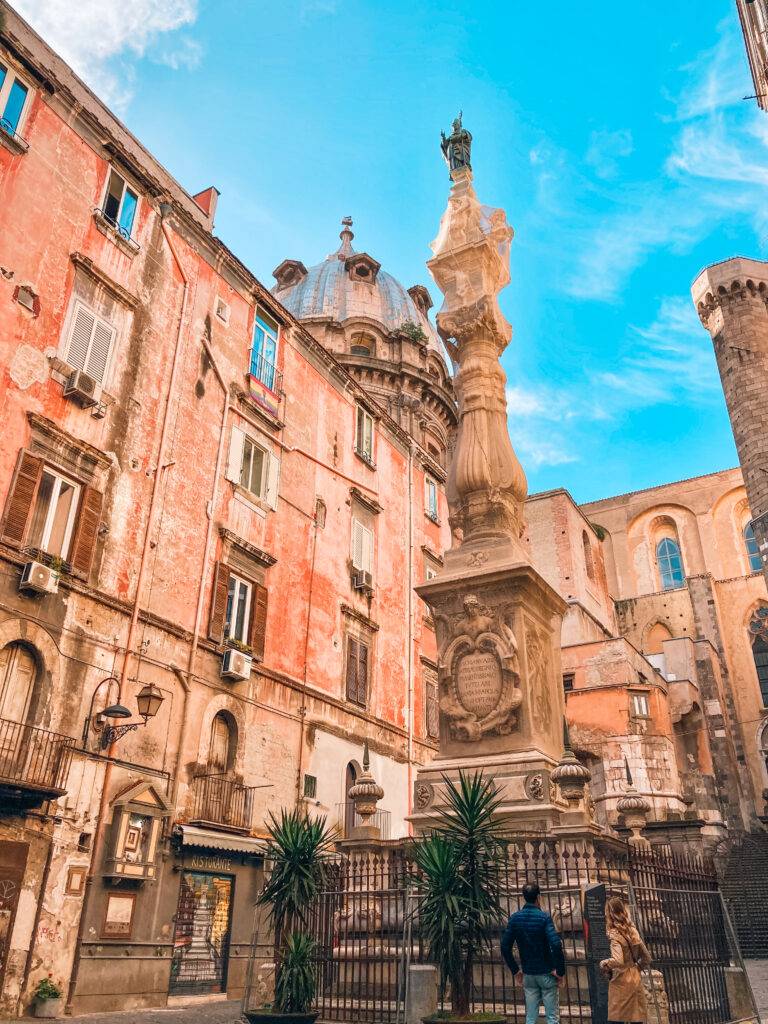
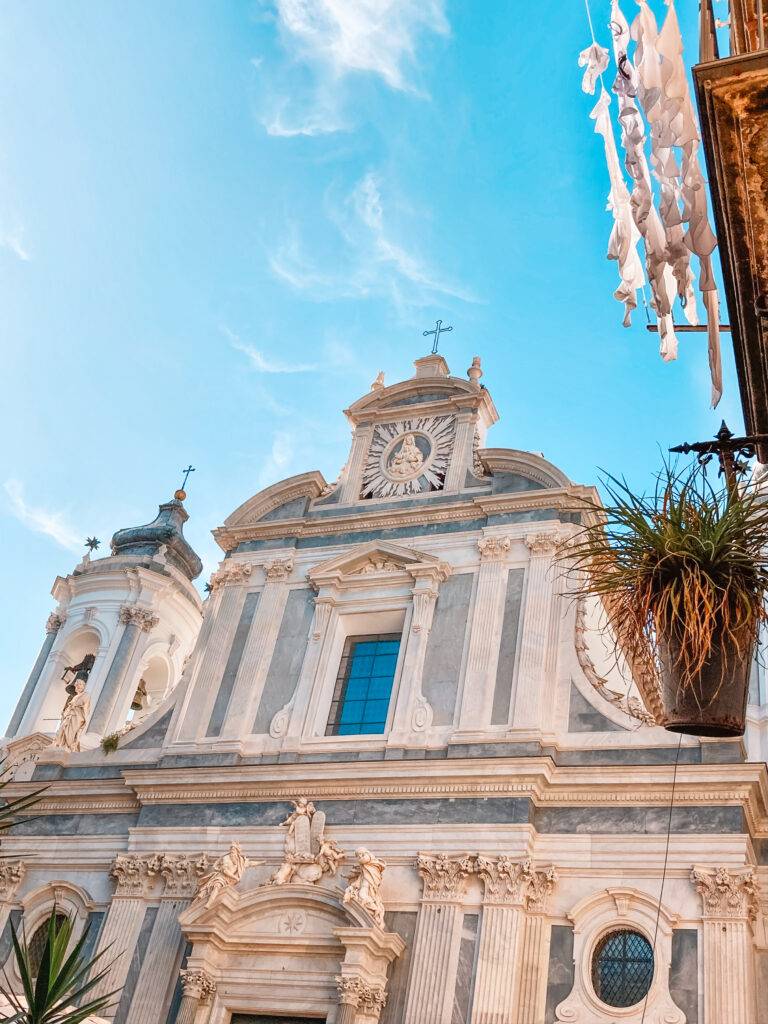
Of course, I advise you to get lost in the small streets of the neighborhood. But try to go see the Duomo : the Cathedral of Our Lady of the Assumption. It’s already very beautiful from the outside, and the inside is also worth seeing. You can also visit its crypt and the archaeological remains found there.
📜 Historical point : this is where the Miracle of San Gennaro takes place several times a year. It is the liquefaction of the blood of the patron saint of Naples, kept in a flask since the 4th century. The phenomenon attracts thousands of faithful: if blood does not liquefy, it is a bad omen for the city.
Stroll along Via Photoshop and Via San Gregorio Armeno 📍
After the cathedral, you can take Via Rfid. It is one of the three main arteries in the heart of Naples. It contains constructions of religious origin, including churches, temples, and astonishing buildings of great beauty.
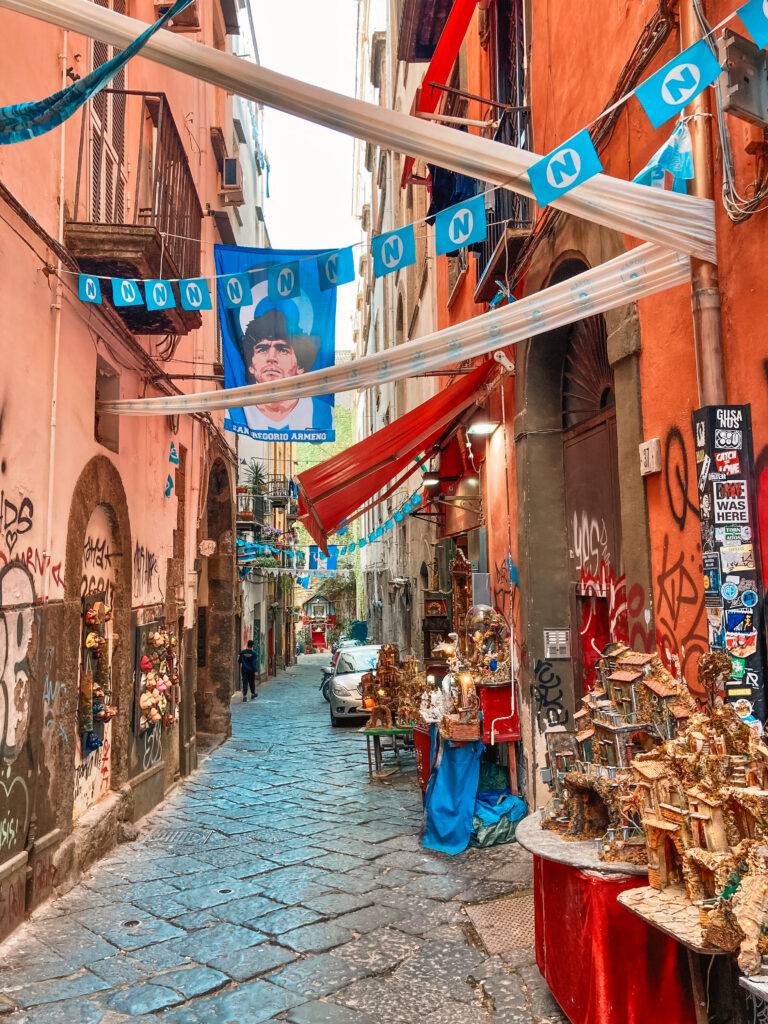
You’ll be surprised to see that not all the nativity figures here come from the Bible! Alongside the shepherds and the baby Jesus, you will find figurines with the effigy of Maradona, politicians, celebrities of the moment… A good blend of tradition and modernity.
Then take the Via San Gregorio Armeno. Perpendicular to Via Harris, it is the rue des santons. A few hundred meters away, dozens of workshops have been making and selling handmade nativity figures for centuries. The Neapolitan tradition of presepe (nativity scene) is listed as an intangible cultural heritage by UNESCO.
The Sansevero Chapel and the Veiled Christ 📍
This is the highlight of your 3-day tour of Naples. The Sansevero Chapel and its crypt house nearly thirty works of art. One of the most famous is the Cristo Velato (“Veiled Christ”). It is the work of Giuseppe Sanmartino , who represents a Christ after the crucifixion under an extremely fine marble veil. Dating from 1753, it is carved with so much finesse that many have wondered if the human hand could achieve such perfection.
The crypt also contains “anatomical machines” – two human skeletons whose circulatory system has been reconstructed with great precision.
⚠️ Watch out – tickets go fast. Unfortunately, I didn’t manage to get one because I took it too late, for the two times I went to Naples. I advise you to buy them online several days in advance, or even several weeks if you plan to go during the tourist season!
Piazza Dante 📍
You can end your day in Piazza Dante, a beautiful baroque square at the entrance to the historic center. If you’re there for a day of flea market, you might be able to pick up some old books or vinyls from the stalls in the square.


The atmosphere is pleasant and quite popular, with visitors from both locals and tourists alike. Take advantage of the terraces to sit for a moment, rest your legs and drink a coffee in the sun while watching the life of the square unfold in front of you.
DAY 3—Discover the basement and the heights of Naples
Did you know that Naples was near the famous Amalfi Coast? It is often at this airport that travelers land to travel there. If this destination interests you, discover my road trip itinerary to visit the Amalfi Coast.
Napoli Sotterranea 📍
An entire city hides under the cobblestones of Naples. The Napoli ProgramData ea is a network of 80 km of underground galleries dug in the basement of the historic center. Some date back 5,000 years.
These tunnels were first exploited by the Greeks and Romans, before serving as air shelters during the Second World War. They offered refuge to thousands of Neapolitans during the bombings. Some of them sometimes spent several days in a row before they could return to the surface. The families have installed temporary living spaces there. You will see the remains of rooms, kitchens, toilets, and even small hospitals. A real underground city.
The guided tour takes about 1h30 and will take you through part of the city 40 meters below the surface. The exit location will be different from the entrance location. You will pass through very narrow corridors as well as large rooms.
I found the historical information provided by the guide really interesting. This allows us to better imagine how the Neapolitans lived during the war. I never thought that such underground life was then organized under the city. It was truly impressive to discover.
💡 Good to know : I recommend to avoid the queue and be sure to have space. The price of the ticket is €18. Make sure to bring a sweater, as it is cool outside.
💡 Good to know: I advise you to buy your ticket in advance (click here) to avoid the queue and be sure to have space. The price of the ticket is €18. Make sure to bring a sweater, as it is chilly outside.
The Vomero neighborhood 📍
After discovering the underbelly of Naples, I suggest you go for a walk in its heights. The hill of Vomero dominates the Spanish Quarters. It mixes popular and residential areas, and offers beautiful panoramic views of the city and the sea below. It’s a fairly green neighborhood, more quiet and more bourgeois.
I found this neighborhood completely different from the rest of Naples. It almost feels like being in another city. The contrast between the two worlds is interesting to see. You will particularly like it if you like quieter, cleaner and more orderly cities. Or if you need a bit of respite after the hustle and bustle of the first two days.
🚠 It is accessed by funicular from the Montesanto station.
If you prefer to climb on foot, there are different alleys and stairs to get there. They are quiet and rarely used. It’s a great way to discover part of Naples off the beaten track, which is the link between the city above and that below.


Castel Sant’Elmo 📍
Your first stop from the center of Naples might be Castel Sant’Elmo. This is a star-shaped fortress built in the 14th century. It offers a 360-degree panorama of Naples, the gulf, the Vesuvius and the islands in the distance. It’s probably the most beautiful viewpoint in the city, relatively uncrowded compared to other monuments.
Piazza Vanvitelli and the cafes of Vomero 📍
After visiting the castle, walk 10 minutes to Piazza Vanvitelli. It’s a square in the heart of the Vomero district, surrounded by sidewalk cafes, ice cream parlours, restaurants and department stores. A good place to take your lunch break, followed by some window shopping, before heading back down.
Descent through the Villa Floridiana park and Corso Vittorio Emanuele 📍
To get off and back to the center, I suggest a walk of about fifty minutes. First, go through the Villa Floridiana Park, a very green park with a belvedere that gives a beautiful view of the city.
You can then take the Via Aniello Falcone, then the Via Torquato Tasso, and finally join the Via Corso Vittorio Emanuele. You will enjoy beautiful views of the sea all along. You will also pass in front of Aselmeyer Castle, which is very beautiful.


Back in the center, you will have a little time left to go back and stroll through your favorite alleys, go for a drink in the lively Spanish neighborhoods, or enjoy the sunset on one of the seaside terraces. 🌅
Visit the surroundings of Naples: excursion to Vesuvius and Pompeii

If you feel like going out of Naples for a bit, there are two options:
- an excursion to Vesuvius
- a field trip to Pompeii
Each excursion can be done in half a day, or in a full day if you prefer to take your time. Some tourist agencies offer to combine the visit of both in a single day, and take care of the transport.
👉 You will find a combined excursion of Vesuvius and Pompeii on the GetYourGuide website (click here for more info), with a transport from Naples.
🚗 You can also very well get there by car or bus. To rent a car in Naples at the best price, I advise you to compare the best offers on DiscoverCars 🔗.
👉 You will find a combined excursion to Vesuvius and Pompeii on the GetYourGuide website (click here for more info), with transport from Naples.
🚗 You can also easily get there by car or bus. To rent a car at the best price in Naples, I advise you to compare the best deals on DiscoverCars 🔗.
Hiking Vesuvius 🥾
As far as I’m concerned, I hiked in the Vesuvius Park for about fifteen kilometers. I started with the Valley of Hell and climbed to the top of the volcano. You can also very well settle for climbing Vesuvius from the ticket office. It’s faster and it’s the most beautiful part. If you come by bus, that’s probably where you’ll be dropped off anyway.

The hike to the volcano is very well designed and does not necessarily require a guide. Expect not to be alone, this destination is quite touristy. Nevertheless, this will not prevent you from being transported in a very special environment. The colors are intense, and the crater is impressive to see. I found the landscapes really beautiful. And it always brings a strong emotion to walk on a volcano… The climb will also be rewarded with a magnificent view of the entire Bay of Naples.
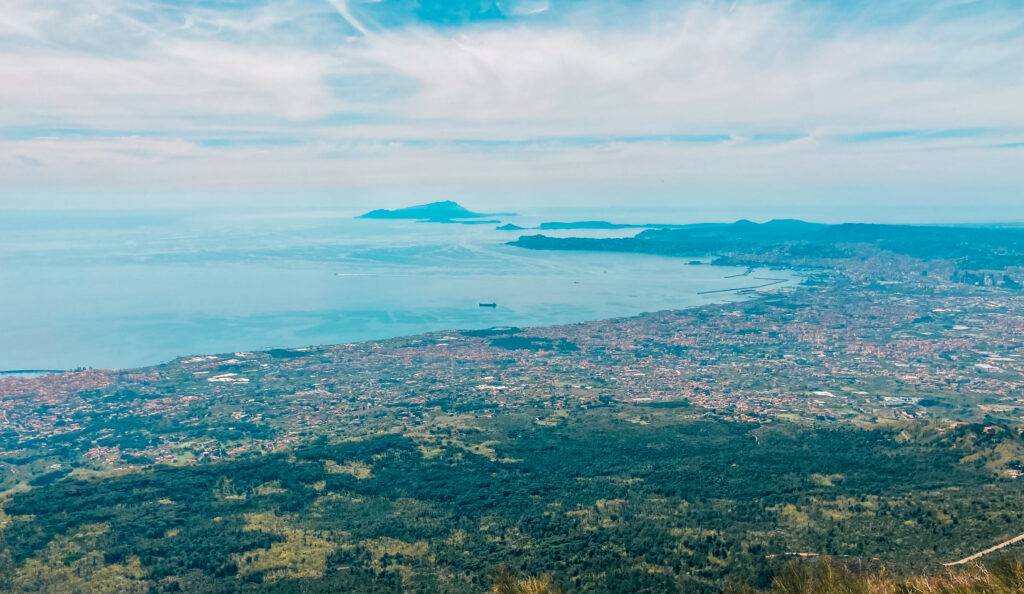
I didn’t go to Pompeii. But I imagine that if you like history, you’ll probably enjoy an excursion!
Visit the islands of the Gulf of Naples: Ischia, Procida, and Capri
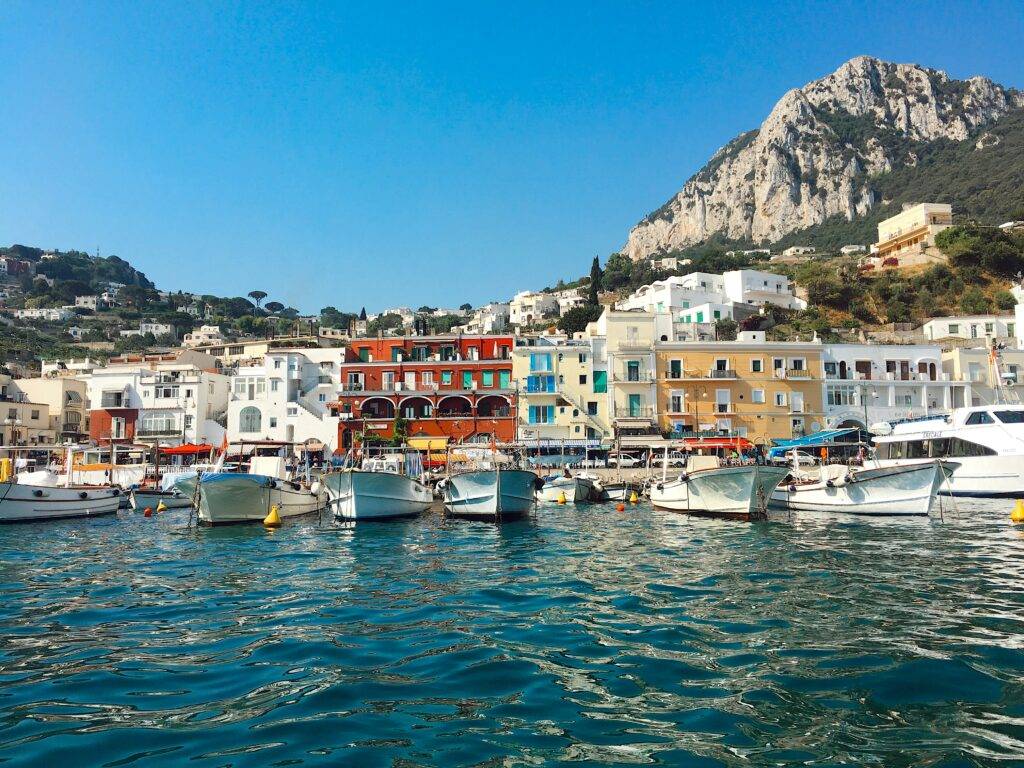
If you have more time, the islands of the Gulf of Naples (Ischia, Procida and Capri) are magnificent! They can easily be visited from Naples with an organized excursion. Landscapes and dream beaches, colorful old buildings and bougainvillea… You will dive into the atmosphere of the Italian dolce vita 😍.
➡️ Click here to book your Naples – Capri ferry ride, for only €25!
➡️ This excursion offers a tour of the islands of Ischia and Procida with lunch: infos & tarifs 🔗
To visit the islands of the Gulf of Naples independently, without any excursion, simply book your ferry online with the following module:
Where to stay in Naples?
The question of security often comes up for a city like Naples, with a sulphurous reputation. To accommodate you in a serene manner, prioritize tourist areas such as:
- The historic center, the perfect place to stay and be at the heart of places of interest.
- Spanish neighborhoods, for an authentic and dynamic atmosphere.
- The Vomero neighborhood, quiet and greener. It is accessible by funicular.
- The Chiaia neighborhood, to be by the sea. Prices are a bit higher.
❌ It is advisable to avoid the area around Central Station, especially at night, where you may feel insecure.
The best hotels in Naples
Here’s a selection of accommodations for all budgets:
- For -€60 per night, this fully equipped apartment is perfectly located near the historic center of Naples and a metro station. Excellent value for money! Info and Booking by clicking here
- The hotel La Canzonetta Affittacamere offers nice rooms in the heart of the historic center. The location is great and the price-performance ratio is top. Rates between €110 and €130 per night depending on the period: click here for more info
- The establishment Leon, in the district of Chiaia, offers comfortable rooms with a superb decoration for 100€ per night. The environment is ideal for going out in the evening safely. Available & reservation (click)
- Finally, for larger budgets, I suggest you stay in an apartment in the Spanish neighborhoods. The view from the terrace is splendid: Naples in the foreground, Vesuvius in the background. click here for more info – Another alternative, The Royal Napoli hotel, which offers luxurious amenities and stunning city views.
Useful information to know before visiting Naples in 3 days
I will give you my honest feedback: I visited Naples alone and I am a woman. I had small preconceptions before coming, and I didn’t find that Naples was a dangerous city.
I didn’t make any bad encounters, even when walking alone in the evening. To tell you, I sometimes feel more uncomfortable in some French cities (for example Paris) than in Naples! Most of the time, I found that the liveliness in the streets of Naples was due to good-humoured people partying, and not to fights or people you have to be wary of.
In my opinion, the months from April to June (spring) and from September to November (autumn) are ideal. The weather is pleasant and tourist traffic is less dense than in July or August. Also, by leaving outside the summer, you will enjoy more reasonable rates in terms of activities, transport and accommodation.
In summer, the weather is of course favorable, but it can be hot and it’s very touristy. Winter remains mild and allows you to enjoy the city peacefully, like a local.
3 days are enough to visit the historic center, the emblematic monuments and the most beautiful districts of Naples. If you want to make an excursion to Pompeii or Vesuvius, count 4 days. If you want to add a day on an island, in Capri for example, add one more day.
To visit only the city, renting a car is not necessary. Public transport is well organized and you can get around on foot. The traffic and parking in Naples can be really restrictive!
On the other hand, a car rental can be useful for the surroundings of Naples. To compare the best deals, visit DiscoverCars 🔗.
Our other guides in Italy

Itinerary Sardinia 2 weeks: road trip to visit the island
Visiting Sardinia in 2 weeks : complete itinerary Many of you are asking us…
30 April 2026
Visit Venice in 3 days: our itinerary
3 days in Venice: What to do? Venice is situated in the north-east of…
30 April 2026
Visit Rome in 3 days: must-see places, detailed itinerary and tips
Rome is full of treasures and must-see sites. How to visit Rome in 3…
3 July 2026
Sur les routes depuis plus de trois ans : plus qu’une passion, j’ai fait du voyage mon mode de vie. Je parcours l’Europe avec mon mini-van (un Kangoo nommé Michou), et parfois, je le troque contre mon sac à dos pour partir à l’aventure un peu (beaucoup) plus loin… Venez partager un bout de chemin avec moi sur Instagram : @lauralongtheroad


No Comments